Best Hairstyles for Black Men in 2026 - Trending Black Male Haircuts 2026
Have you still not found a satisfactory answer after searching for the best hairstyles for Black men? The root of the problem might be that they only tell you what to get, but never how to choose the right variation for you. A haircut that looks amazing on one guy can fall flat on another, and it all comes down to your hair texture, face shape, hairline, and personality. In this 2026 Black men's haircuts guide, follow us to find the best style for different males, not just chasing the trend.
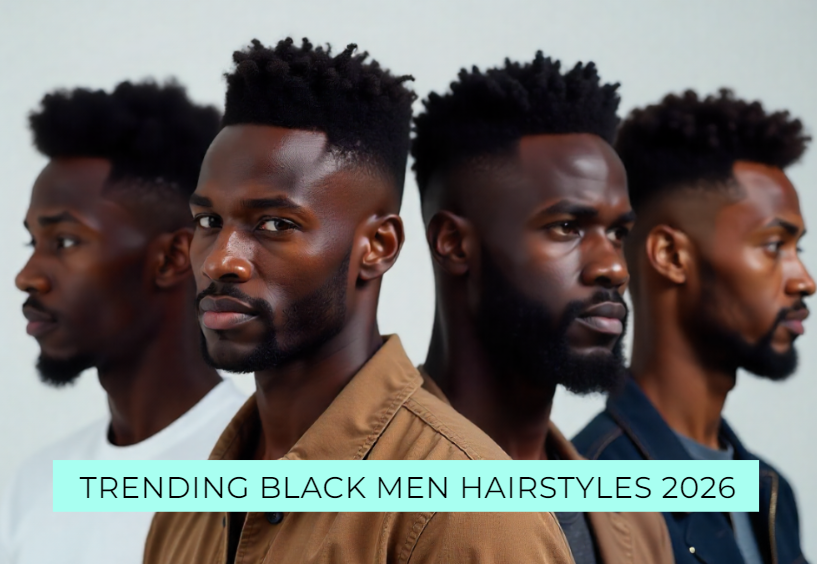
Top Trendy Black Men Haircuts & Hairstyles 2026
In 2026, choosing the right haircut is all about working with your natural features, not against them. Below are trending hairstyles for Black men this year, ideal for both tight, coily Type 4 afro hair and looser Type 3 curls.
1. 360 Waves with Drop Fade
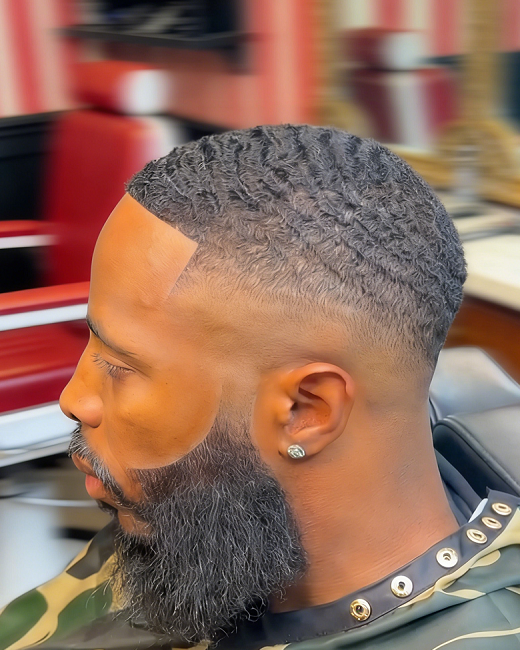
You can never go wrong with a classic, and 360 waves are here to stay in 2026. To keep up with the latest trend, you can pair this cut with a clean drop fade, which curves around your ears and slopes down toward your neckline, and frames your waves perfectly.
Who It’s Best For: Black men with Type 3 or Type 4 hair; Square & oval face
2. Taper Afro
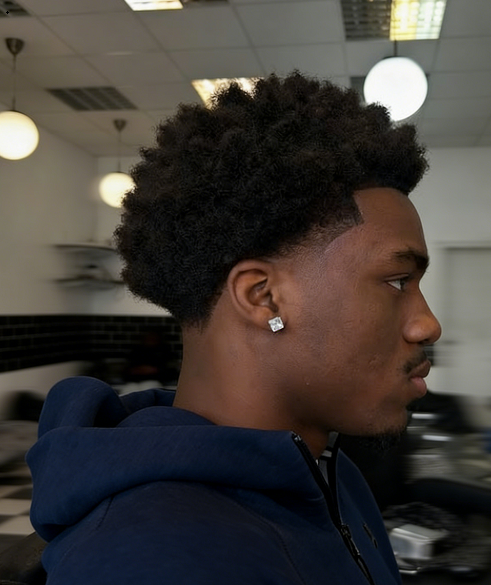
Taper Afro is a classic Black men’s hairstyle defined by tapered sides and back paired with a full, voluminous Afro on top. The sides and nape feature a gradual, gentle taper that shortens slowly without fading down to the scalp, maintaining soft, straight lines rather than sharp curves. The top section consists of natural or permed tight curls with significant volume, sitting loose and fluffy away from the scalp. The overall shape is rounded on top and neatly tapered below. The tapered Afro is also perfect for the awkward growth phase.
Who It’s Best For: Black men with tight, coily Type 4 hair; Round & triangle face
3. Two Strand Twist
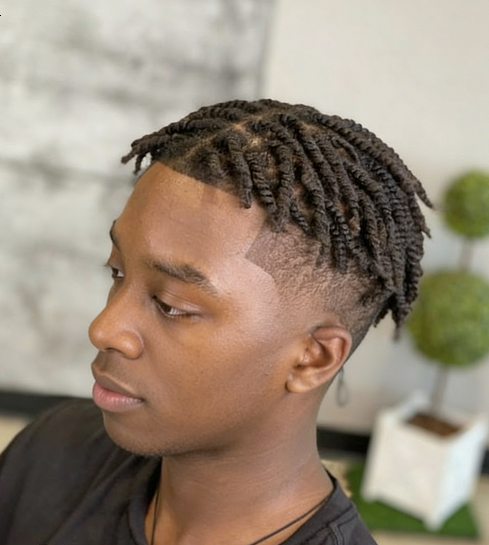
The two-strand twist is one of the easiest and most popular hairstyles among American Black males. It is created by dividing the hair into small sections, with each section twisted using two strands of hair, which distinguishes it from three-strand braids, locs, and other similar hairstyles. It forms clear spiral textures that are neat and tight and has a soft texture without being stiff. Importantly, it is not a permanent hairstyle; the twists can be undone, and the hair will return to its curly state after washing or being taken apart.
Who It’s Best For: Black men with Type 3 or Type 4 hair; Oval face; Long, medium, & short hair
4. Cornrows with Fade
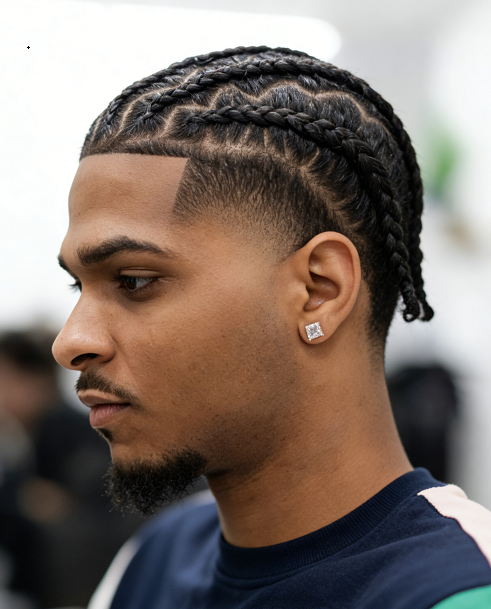
Cornrows with fade is one of the common Black men’s hairstyles in hip-hop, sports, and street cultures worldwide. It combines two core elements: cornrows on the top and a fade on the sides and back of the head. Cornrows refer to tight, scalp-hugging braids woven in parallel rows that run backward in a field. These braids are created with three strands, lie flat against the scalp without being raised or suspended, and feature a high sense of neatness and line. They can last for several weeks and remain tidy even during physical activities, with common styles including straight lines, diagonal patterns, snake-like designs, decorative patterns, and side parts. The fade part of the hairstyle involves a gradual tapering of the hair on the sides and back, shortening from longer to very short or even bald, creating clean lines and a clear contour.
Who It’s Best For: Type 3 or Type 4 hair; Diamond or triangle face
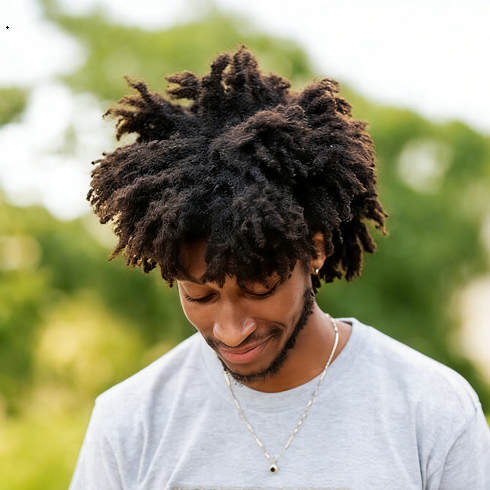
5. Freeform Locs
Freeform Locs is a type of Dreadlocks (locs) that requires no grooming or manual braiding at all. It is formed by letting the hair naturally knot, tangle, and clump on its own without combing, twisting, braiding, or maintenance. It is distinguished from regular locs, two-strand twists, cornrows, and other similar hairstyles by its completely natural formation. It features extremely uneven thickness—some are thick, some are thin, and some are connected together, with no regularity, neatness, or uniformity. The surface of freeform locs is frizzy and irregular, not smooth, sleek, or tight, with fuzzy edges. Importantly, it is a permanently formed hairstyle; once clumped, it cannot be undone and is not a temporary look—it can only be removed by cutting.
Who It’s Best For: Black men with Type 3 or Type 4 hair; Any face shape; Long or medium hair
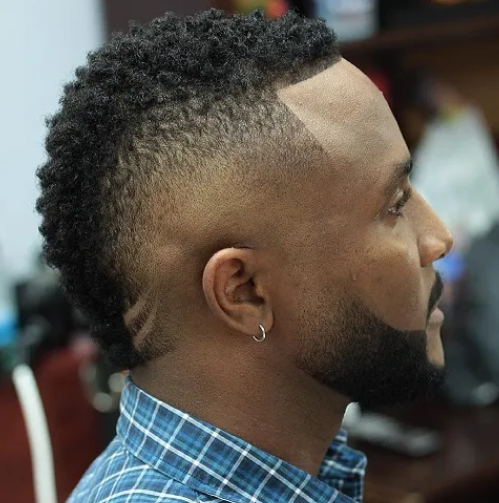
6. Burst Fade Faux Hawk
The burst fade faux hawk is more low-key than a Mohawk and more fashionable than a regular faux hawk. A burst fade refers to a tapered cut that "bursts" in a semicircle around the ears, with the area behind the ears shaved very high and clean. Unlike a straight or downward-curving taper, it has an outward-bursting shape, forming a semicircle around the ears. The faux hawk, the other key element, features hair on the top of the head that stands upward overall, with the middle part higher and the sides lower. It is not a narrow, stiff strip (which is a Mohawk); instead, the entire top section is fluffy with a natural transition. The top hair can be textured, curly, short, or long.
Who It’s Best For: Round or oval face shape; Men with short to medium hair
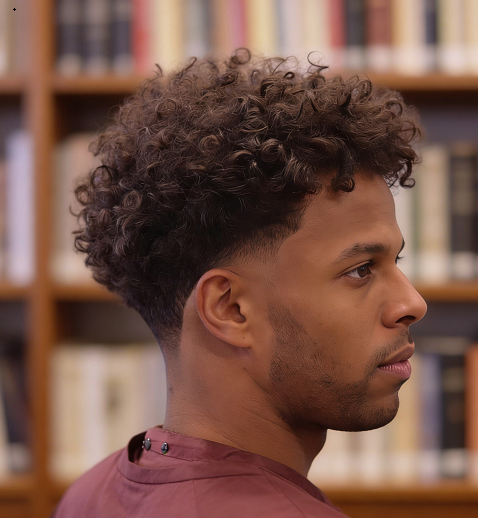
7. Curly Low Taper
A curly low taper is defined by natural curly hair on the top paired with a gentle, low taper on the sides and nape. The top section features natural curls that are not permed, twisted, or braided—retaining the hair’s original texture, which is fluffy, soft, and elastic, without being straightened, flattened, or having its curl pattern damaged. The low taper, on the other hand, starts to gradually shorten slowly from the area below the ears and the lower part of the nape; it does not fade down to the scalp or leave the skin exposed, maintaining a good amount of hair volume.
Who It’s Best For: Type 4A/4B/4C and 3A/3B; Oval faces, diamond faces, and square faces; High hairlines or M-shaped hairlines
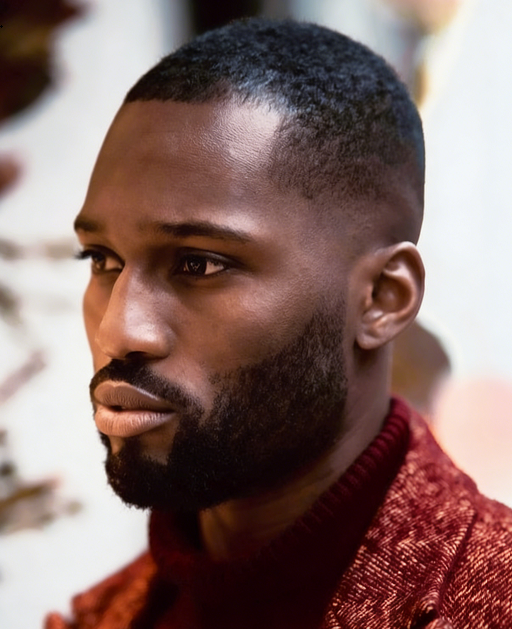
8. Buzz Cut with Beard
You can’t talk about Black men’s haircuts without mentioning the buzz cut; it’s simple, timeless, and always looks sharp. In 2026, the trend is pairing a buzz cut with a well-groomed beard— it’s the ultimate masculine combo that never fails. The buzz cut is short all over, highlighting your head shape and bone structure, while the beard adds warmth and balance.
Who It’s Best For: Any hair type; Square and oval face; Black guys with a receding hairline
Best Twist/Braid Hairstyles for Black Men & Boys 2026
Braids and twists are both protective styles for Black men, as they keep your hair safe when it grows, last for weeks, and come in lots of variations. But not all braids and twists suit everyone. Choose the cut that fits your hairline strength and texture, and avoid tight installations that can cause damage and traction alopecia.
Two-strand twists: One of the safest choices would be two-strand twists; they are suitable for guys with fragile hairlines, thinning temples, or anyone who wants low-risk hair growth. Two-strand twists distribute tension evenly across your scalp, so less stress on your hair follicles. This style works best for men with 4B and 4C hair textures. The tight coil pattern of these hair types holds the twisted shape well, so your twists won’t unravel easily.
Stitch braids: Stitch braids are ideal for men with solid, healthy hairlines—they can handle the front exposure and slight tension of the style. They work well with all 4A, 4B, and 4C textures, as long as your hair is long enough to braid (at least 2–3 inches). Many celebrities have rocked this style in recent years. The horizontal lines add visual width to your face, which balances proportions if you have a long, narrow face.
Best Fade Haircut for Black Men & Boys 2026
Fades are the foundation of most men’s hairstyles in 2026, but most guys don’t realize there are four main types—and picking the wrong one can throw off your entire look. A fade that looks sharp on an oval face can make a round face look like a balloon, and vice versa. The key is to choose a fade that balances your face shape, not works against it.
Low Taper Fade: This is the safest fade haircut; it starts at the bottom of your ear and neckline, with a subtle gradient that blends into your hair on top. Because it’s subtle, it doesn’t dramatically alter your face proportions—so it works for almost every face shape. Pair it with waves or a short curly top for a classic, timeless look.
Drop Fade: The drop fade is a fan favorite in 2026. Different from other fades (which go in a straight horizontal line), the drop fade curves down behind your ear, following the natural shape of your skull. This makes it look more organic and blended, with no harsh lines. It’s been a favorite among celebrities for years, and it pairs perfectly with braids or long hair on top. The drop fade also works for almost every face shape, but it’s especially good for square and oval faces. It softens sharp angles (great for square jaws) and enhances balanced features (perfect for oval faces).
Best Locs Hairstyles for Black Men 2026
Locs take time to grow and maintain, so you can’t just switch styles quickly. In 2026, the two main types of locs are cultivated (structured) locs and free-form locs. The choice between them depends on your personality, lifestyle, and how much time you want to put in.
Cultivated Locs with a Fade: Cultivated locs are the polished, structured version of dreadlocks. They require regular retwists (every 4 to 6 weeks) to keep the parts clean and the locs neat. Most guys pair cultivated locs with a fade on the sides—this adds contrast and keeps the style functional. The locs on top add personality, while the fade keeps the look from being too messy.
Freeform Locs: The opposite of cultivated locs, they require no retwists, no manipulation, and no strict maintenance. You let your hair loc naturally, which means the locs will have irregular sizes, organic shapes, and a look that evolves over time. Freeform locs are perfect for guys in creative fields (artists, musicians, designers) or younger men who want a unique, non-conformist look. However, they take 12 to 18 months to mature, so you need patience: for the first few months, they might look like uncombed hair.
Best Haircut for Black Men with Receding Hairline & Thinning Hair
Not every guy has a full head of hair, and that’s okay. In 2026, the most confident look for men with receding hairlines, thinning hair, or no hair at all is to own it. A buzz cut or full shave, paired with well-groomed facial hair (a beard, goatee, or stubble), shifts the focus from your hair to your facial features—and it’s incredibly masculine. If you have a patchy beard, keep it short (stubble) or try a disconnected goatee.
Factors to Consider for Choosing the Best Haircut for Black Males
Face Shape: Your face shape (round, square, diamond, oval, or heart) is one of the most important things to think about. A style that makes a round face look slimmer might not work for a long face; it’s all about balancing your features.
Hair Texture & Curl Pattern: Not all styles work for all curls. Tight coils need different cuts than loose curls; the best styles will highlight your natural texture, not hide it.
Hairline & Forehead: If your hairline is receding, avoid styles that expose your forehead too much. Use your hair to frame your face in a way that feels comfortable and confident.
Lifestyle & Maintenance: Be honest with yourself, do you have time to retwist your hair every few days, or do you need something low-effort? Pick a style that matches how much time you can spend on upkeep.
Beard Style: Your hairstyle and beard should work together. If you have a thick beard, a clean, neat haircut on top will balance it out. If you have a baby face, more volume on your head can add structure.
Black Men Hair Texture & Curl Patterns
Most Black men have hair types in the 4A, 4B, or 4C category—and this is the foundation of choosing any hairstyle. 4A hair has defined S-shaped curls, like tight spirals about the width of a pen. 4B hair has tighter Z-shaped patterns that look fluffier and don’t clump as easily. 4C hair has the tightest coil pattern, with no visible curl definition unless you style it. What’s important to know? 4C hair can shrink up to 70% of its actual length, so 6 inches of 4C hair might only look like 2 inches. Also, the tighter your coils, the harder it is for your scalp’s natural oils to reach the ends, which is why these textures often feel drier. Keep this in mind as we go through each style—your hair type will make or break how a cut looks on you.
How to Pick the Right Haircut for Your Face Shape
Make sure to get the best results and avoid getting frustrated after visiting the barber shop. Choose the haircut for your face shape.
Square Face: You have a strong jaw and equal width across your forehead and cheeks. Go for styles that sharpen your features, such as 360 waves, a refined high top, or a taper fade. Avoid styles that widen your face.
Round Face: You have full cheeks and soft edges. Add angle with sharp lineups, temp fades, or styles with height (like a refined high top or taper Afro). A beard will also add structure.
Oval Face: You’re lucky— almost every style works! Waves, twists, Afros, locs, and buzz cuts all look great. Just avoid bangs that cover your forehead (they can make your face look rounder).
Diamond Face: You have a narrow forehead, wide cheekbones, and a pointed chin. Balance your features with medium Afros, locs, or twists (they add width to the top). Avoid super short cuts that expose your forehead.
Triangle Face: Your forehead is wider than your jaw. Add volume lower down with a taper afro or braided styles that hang. A beard will also balance your features.
Long (Rectangle) Face: You have a tall forehead and a longer face shape. Go for texture, not height— short curls, tapers, or free-form locks work great. Avoid tall styles like an exaggerated high top (they’ll stretch your face even more).
Hair Care Tips for Black Men
A great haircut is only as good as how you maintain it. Here are the must-have tips for keeping your hair healthy and your style lasting longer in 2026:
Wash and Moisturize: Afro hair is naturally dry, so use sulfate-free shampoos and conditioners. Deep condition once a week to add moisture, and keep hair oil on hand for daily touch-ups.
Keep Your Lineup Fresh: Fades and lineups dull fast— do at-home touch-ups with a good trimmer to keep your style sharp.
Protect Your Hairline: When getting protective styles (braids, twists), avoid tight installation. Give your hair a break between styles to prevent damage.
Sleep Smart: Use a satin or silk pillowcase, or wear a durag/bonnet at night. This locks in moisture and prevents breakage.
Scalp Health: Wash your hair weekly or bi-weekly (don’t wash daily— it dries out your scalp). Massage your scalp with natural oil to boost blood flow and promote growth.
Balance Hair and Beard: If you have a beard, keep it well-groomed to balance your haircut. A crispy beard fade pairs perfectly with almost any style.