

This straight bob frontal lace wig is ideal for Black women’s facial features and wearing habits, adopting 100% real human hair material, with smooth and supple hair texture that is completely close to natural straight hair, no fake shine or stiff sense. It is equipped with a pre-plucked natural hairline design, which perfectly restores the real baby hair growth state, fits the scalp seamlessly after wearing, and achieves an invisible wearing effect easily.
Can Black People Have Straight Hair - How to Straighten African Hair
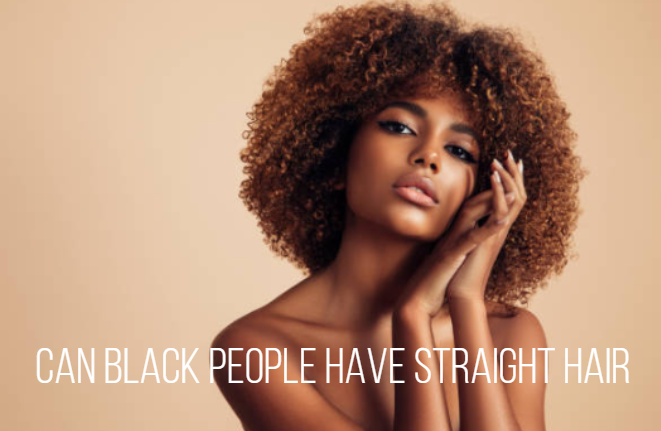
Africans impress the world deeply with their iconic curly hair textures, and many people take it for granted that all Black individuals only have kinky or curly hair. In fact, Black people, including Africans and African Americans, are able to own straight hair either naturally or through external styling. Today, we will comprehensively talk about whether Black people can have natural straight hair, the core causes for their typical curly hair, common reasons for hair straightening, practical straightening methods, ideal straight hair wigs, and trendy straight hairstyles for Black women.
Updated (May 2026):
Can Black People Have Straight Hair?
Yes. Black people can be born with naturally straight hair, though this phenomenon is extremely rare in the Black community. Most descendants of African origin are born with Type 3 curly hair or Type 4 coily/kinky hair, while natural straight hair only appears among a small crowd.
What Percentage of Black People Have Naturally Straight Hair?
Multiple academic research studies and real-life population statistics confirm that less than 1% of the global Black population owns pure natural straight hair, and around 1%-2% have soft natural wavy hair close to straight texture. Among them, East African ethnic groups such as Ethiopians, Somalis, and Eritreans have a higher proportion of people with natural straight or semi-straight hair compared with West Africans and African Americans.
Why Do Some Black People Have Straight Hair?
The main causes of natural straight hair in Black people cover three aspects. Firstly, genetic admixture is the leading factor; long-term ethnic intermarriage brings European, Asian, or indigenous ancestral genes carrying straight hair traits, which are inherited and expressed in later generations. Secondly, rare genetic mutations can change hair follicle structures and keratin composition, forming straight hair strands even among full-blooded African descendants. Thirdly, dormant ancient ancestral hair traits may reappear through heredity. Besides, about 10% of Black people carry special straight hair-related genetic variants, which are more common in other ethnic groups and occasionally manifest in Black groups.
Why Do Black People Have Curly Hair?
Innate genetic structure: Almost all native African people have flat and ribbon-shaped hair follicles, which naturally grow tight, coily hair. This genetic trait has been stably passed down for thousands of years, becoming the mainstream hair feature of African groups.
Physiological adaptive evolution: Africa features high temperatures and strong ultraviolet radiation. Tight curly hair can form gaps between hair strands, effectively block strong UV rays to protect the scalp from sun damage, and help sweat evaporate quickly to lower body temperature and adapt to hot tropical climates. By contrast, straight hair is easy to gather heat on the scalp, so it was gradually eliminated in the long-term natural selection process in Africa.
Sebum distribution limitation: The tight curling structure makes scalp sebum unable to spread evenly along hair shafts, resulting in dry, brittle, and rough hair texture, which further fixes the curly hair form of Black people.
Why Do Black People Choose to Straighten Their Hair?
Historical and cultural aesthetic influence: For a long period of time, Eurocentric aesthetics took straight hair as the mainstream beauty standard. In American history, natural, coily Black hair was once labeled with negative impressions. Many Black people straightened their hair to cater to mainstream social aesthetics and integrate into public social circles. From the 1960s to the 1980s, most Black celebrities also chose straight hairstyles for film and television performances due to insufficient diverse aesthetic representation.
Professional workplace demands: Affected by lingering social biases, neat straight hair is still regarded as more formal, polished, and professional in many formal working scenarios, prompting many Black professionals to straighten their hair for better career development.
Daily maintenance convenience: Compared with high-maintenance natural tight coily hair, straight hair is simpler to comb, take care of, and manage in daily life.
Hairstyle diversity pursuit: Straight hair supports richer hairstyle collocations, breaking the single styling limit of natural curly hair and meeting people’s needs for different looks.
Personal aesthetic preference: Plenty of Black men and women simply love the smooth, silky visual effect and soft touch of straight hair out of personal taste.
What Factors Determine Hair Texture & Type?
Hair texture is jointly shaped by genetics, biological structures, and external environmental elements.
Hair follicle shape: This is the most decisive factor. Round scalp hair follicles grow smooth, straight hair; oval follicles produce wavy hair; flat or ribbon-like follicles form tight curly and coily hair.
Disulfide protein bonds: More dense disulfide bonds inside hair strands lock hair into tighter curls, while fewer bonds make hair straighter and softer.
Genetic inheritance: Hair texture is a highly heritable physical feature, passed down steadily from parents and ancestors.
Hormonal changes & external environment: Puberty, pregnancy, aging, and long-term heat exposure, chemical stimulation, and local climate can subtly change hair texture temporarily or permanently.
How to Straighten Your Natural Curly Hair?
All straightening methods are divided into temporary heat styling, semi-permanent chemical treatment, and non-damage protective styling, each with distinct effects, duration, and operation tips.
1. Flat Iron Heat Straightening
It is the most common and convenient household temporary straightening method. After fully cleaning and blow-drying natural hair evenly, divide hair into thin sections, spray heat protectant fully, and use constant-temperature ceramic or titanium flat iron to straighten hair from roots to ends. The effect lasts until the next hair wash, suitable for daily wear and temporary styling for parties and dates. Avoid over-high temperatures to prevent hair breakage and dryness.
2. Silk Press
An upgraded, delicate heat straightening technique popular among natural hair lovers. The whole process includes deep shampooing, intensive deep conditioning to supplement hair moisture, low-temperature slow blow-drying, and precise flat iron shaping. It creates ultra-smooth, glossy straight hair without using any chemicals, protects the original curl texture completely, and has more natural luster than ordinary flat iron straightening.
3. Chemical Hair Relaxer & Texturizer
Classic semi-permanent straightening treatment. Apply professional chemical cream to break and reorganize disulfide bonds inside hair, and soften tight curls into smooth, straight hair. The whole operation takes 1 to 3 hours, and the effect lasts until new curly hair grows out. It needs regular touch-ups, and professional salon operation is recommended to avoid scalp irritation and severe hair damage.
4. Permanent Chemical Hair Straightening
Stronger than ordinary relaxers, the whole treatment takes 2 to 4 hours, which can thoroughly change natural hair texture to form silky, smooth, straight hair. The styling effect can maintain 3 to 6 months, ideal for people who pursue long-term straight hair and low daily maintenance frequency.
5. Keratin Smoothing Treatment (Brazilian Blowout)
Infuse hair with pure keratin protein to wrap hair cuticles, reduce hair frizz, loosen original tight curl texture, and enhance hair smoothness and softness. It cannot achieve absolute straightening but greatly improves hair manageability, perfectly fits thick, high-porosity dry Black hair, and the effect lasts for several weeks with proper daily care.
6. Heated Straightening Brush
A labor-saving daily quick styling tool, integrating combing and heat straightening functions. It is suitable for light curly hair and daily simple touch-ups, easy to operate with mild styling strength, and can create natural, stretched straight hair without a stiff feeling.
7. Round Brush Blow Drying
Classic salon styling method. Match a concentrator nozzle hair dryer with a round hair brush, pull hair tight with the brush while blowing hot wind, stretch curly hair to form fluffy, dynamic straight hair with a natural sense of movement, often used as base styling before flat iron straightening.
8. Low-Temperature Hooded Dryer Straightening
A healthy heat styling way with low damage. Fix stretched hair with hair bands, use a hooded dryer with an adjustable low heat setting to dry hair slowly for 40 to 60 minutes. It avoids high-temperature direct burning, locks hair moisture effectively, and makes hair naturally straight after loosening.
9. Physical Wrapping Straightening
After washing hair, use soft microfiber towels to absorb excess moisture, comb hair smoothly, wrap hair tightly around the head, and fix with hair clips, then wear silk nightcaps to sleep. Unwrap hair the next morning to get smooth, natural, straight hair, zero heat, and chemical damage.
10. Protective Extension Styling
Wear braid twists, hair bundles, crochet hair, hair weaves, and other extensions to stretch natural hair and present straight hairstyles. It can maintain straight looks for 1 to 4 weeks, fully protect original natural hair from external damage, and is the most popular non-damaging straightening way for long-term use.
11. Natural Nourishing Smoothing Method
Use hair care products rich in argan oil, coconut oil, and shea butter to moisturize hair, comb unloose braids or twisted hair after air drying, and naturally stretch curls into soft, loose straight waves, which is the mildest straightening way suitable for daily hair care.
Best Wigs for Easy & Fast Natural Straight Hair
For Black women who want perfect straight hair permanently without hurting natural hair, wearing high-quality straight human hair wigs is the most ideal choice, and the wholesale straight bobo frontal lace wig with pre-plucked hair line from Honest Hair Factory is the top pick.
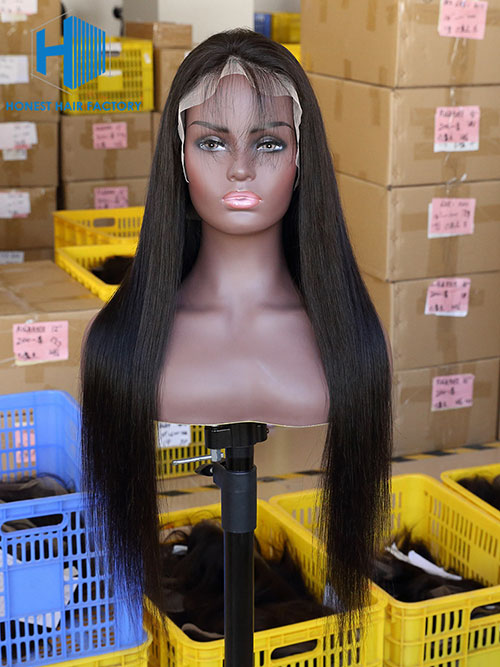
Wholesale Straight BOBO Frontal Lace Wig With Pre-plucked Hair Line
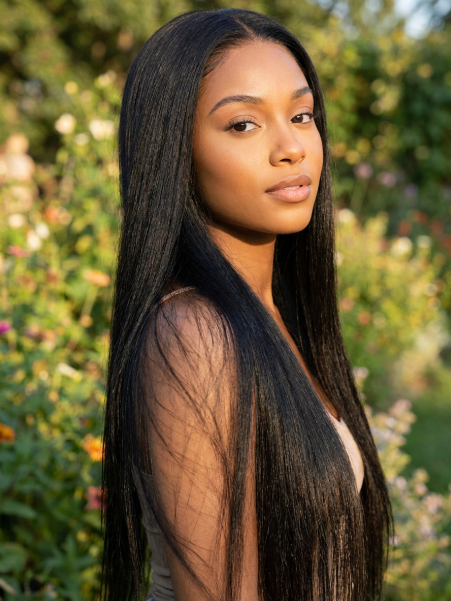
The classic straight wig length is neat, easy to modify facial lines, and suitable for all face shapes of Black women. The breathable frontal lace material is comfortable to wear for a long time without stuffiness, and the human hair wig can be freely permed, dyed, and restyled according to personal preferences. Compared with frequent heat straightening and chemical straightening, this wig completely avoids all hair damage, can be worn daily, for work and parties, and allows users to switch straight hairstyles freely at any time while protecting their own natural hair health. It is cost-effective and practical, favored by countless Black women who love straight hairstyles. Below is a picture of how this wig looks when worn.
Most Popular & Trendy Straight Hairstyles for Black Women
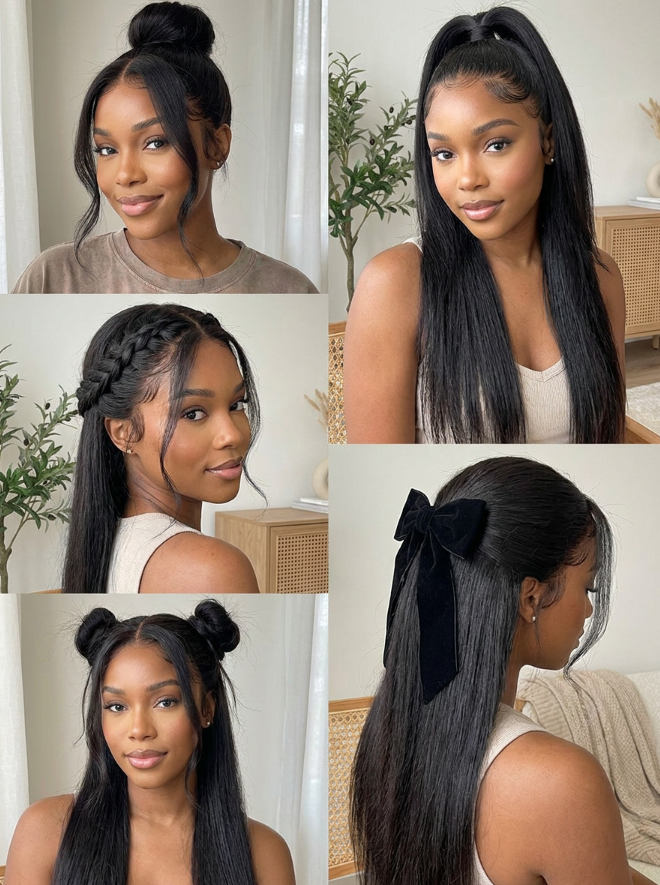
Use the straight bob frontal lace wig, you can get the easy and beautiful Black women's hairstyles quickly, and below is a picture showing the following 5 styles with this wig.
1. Top Knot Bun
Gather all straight hair into a neat high top knot at the top of the head, reserve delicate face-framing side strands, and natural baby hairs along the hairline. The style is neat and fresh, simple and versatile, suitable for daily commuting and casual outings, highlighting a capable and elegant temperament.
2. Half-Up Half-Down Straight Ponytail
Tie the upper part of straight hair into a neat high ponytail, and leave the rest of the straight hair naturally draped over the shoulders. It increases top skull volume, combines neat sense and casual laziness, and presents sweet and fashionable personal charm.
3. Half-Up Braided Crown
Braid the bilateral upper hair strands finely and fix them at the back of the head to form a delicate hair crown shape, match with naturally draped straight hair, and modified baby hairs. The overall style is retro and soft, full of a gentle, elegant temperament, perfect for dating and formal occasions.
4. Double Space Buns
Divide the top straight hair into two parts and make lovely small space buns on the left and right sides, leave most straight hair falling down naturally, and reserve a few loose broken hairs to increase the sense of hierarchy. It belongs to the classic Y2K trendy hairstyle, lively and playful, full of youthful vitality.
5. Half-Up Style with Velvet Bow
Pull up part of straight hair to make simple half-up styling, match with a black velvet bow as decoration, and set off a soft temperament with drooping straight hair. The design is sweet and retro, highly feminine, and easy to match all kinds of daily outfits.
You are one step away to access to our wholesale prices