

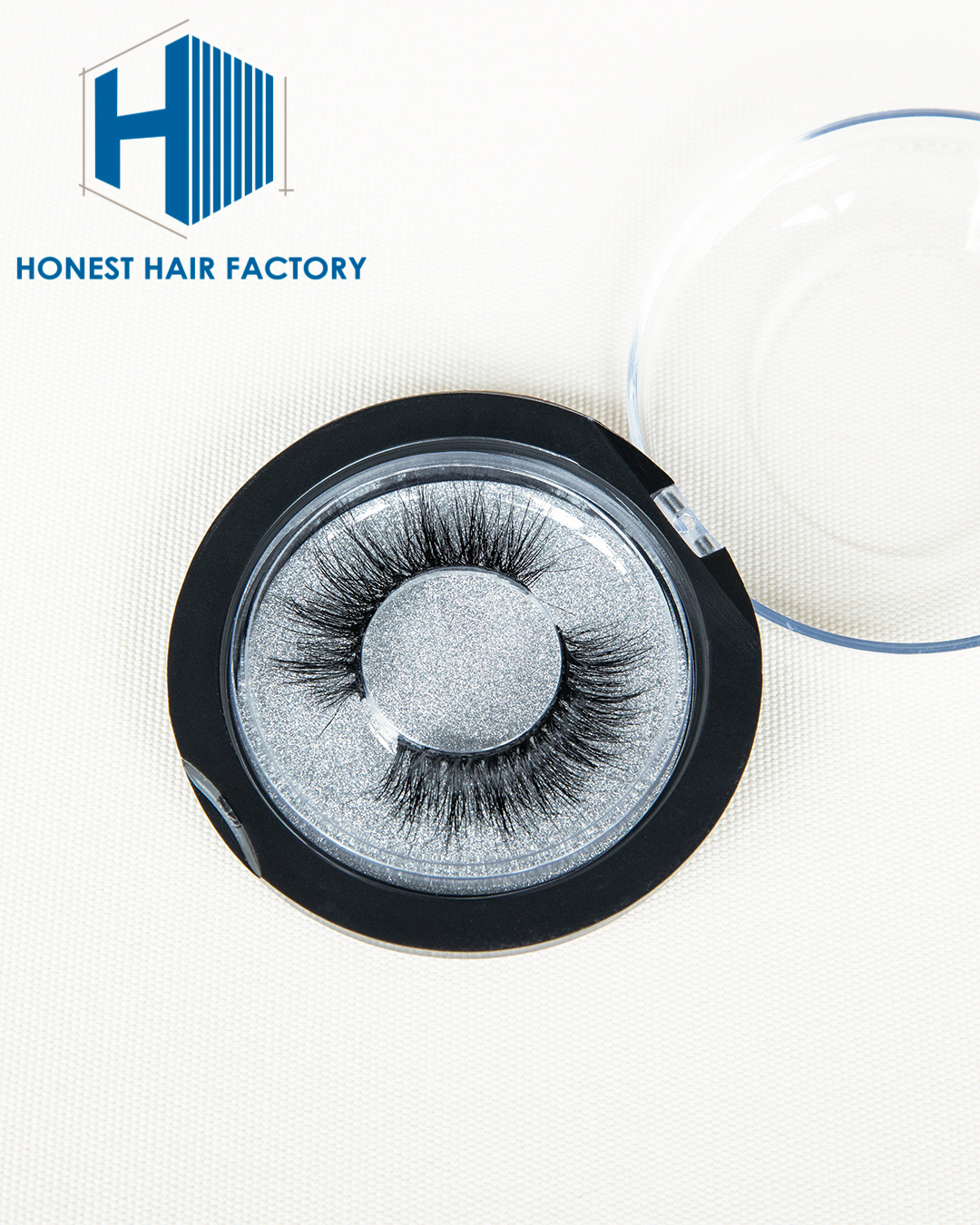
Wholesale S006# 3D Mink Hand-made Fluffy Volume Eyelashes-15-20mm
Eyelash Extension Lengths, Curl Types & Thickness (Diameter) Chart
Choosing the right eyelash extensions can feel overwhelming with so many lengths, curls, thicknesses, and volume sets to pick from. How do you know which combination will look most natural, flattering, and comfortable for your eyes? In this guide, we break down everything you need to know about lash lengths, curl types, and diameter/thickness with multiple charts to help you make the perfect choice every time.
Eyelash Extension Size Chart & Guide
Eyelash extensions can increase your lash density, curl, and definition without the need for daily mascara. Each extension involves multiple dimensions that determine the final look, comfort, durability, and eye-enhancing effect. The eyelash curl defines the lifting effect and eye-opening result; the length influences the style and appearance, while the thickness affects the softness, support, weight, and retention. You can also choose different application methods to get the desired look. To ensure safe and beautiful eyelash extension results, understanding these sizes is critical.
Eyelash Extension Lengths Guide & Chart
Lash extension lengths refer to how long each individual extension is, measured in millimeters (mm). There are short, subtle options and long, dramatic ones, and the right length depends on several factors—including your natural eyelash length, eye shape, desired look, and lash health. Choosing the wrong length can weigh down natural lashes, cause damage, or create an unflattering effect, so it’s important to match length to both preference and practicality. The lengths of eyelashes vary by manufacturer, typically ranging from 5mm to 30mm. The most popular lengths of eyelash extensions are 11 and 12.
Extension Length (mm) | Suitable Natural Lash Length (mm) | Suitable Eye Shapes | Uses |
5-8 (Short) | 4-6 (short, thin, or fine natural lashes) | Protruding eyes; all eye shapes for inner corner filling | Subtle, natural look; filling inner corners; lower lash line; professional settings; clients who want minimal enhancement |
9-12 (Medium) | 7-10 (average or slightly short natural lashes) | All eye shapes (most versatile); round eyes (for subtle elongation); hooded/monolids (mid-outer placement) | Everyday wear; balanced enhancement (natural but noticeable); first-time extension clients; professional and social settings |
13-16 (Long) | 10-13 (long, strong natural lashes) | Round eyes (outer corner elongation); deep-set eyes; hooded/monolids (outer corner placement) | Bold, glamorous look; special events; photoshoots; statement style; strategic placement (center/outer corners) |
17-22 (Very Long) | 12-15 (very long, strong, healthy natural lashes) | Deep-set eyes; round eyes (dramatic elongation); not recommended for hooded/protruding eyes | Extreme glamorous look; performance (e.g., modeling, stage); artistic styles; not for everyday wear |
23-30 (Ultra-Long) | 15+ (exceptionally long, strong natural lashes) | Rarely suitable for most eye shapes; only for specialized artistic use | Specialized artistic projects; extreme statement looks; not for regular wear or most clients |
How to Choose the Best Lash Extension Length?
When selecting the proper eyelash length, these are the most important factors to consider.
1. Natural Lash Length
The length of your natural lashes is the most important factor, as it directly affects how well the extensions can be supported. If natural lashes are short or thin, using overly long extensions can strain the natural lash roots and lead to breakage or premature shedding. In general, it is recommended to pick lash extensions that are 2-3 mm longer than your natural lashes. For example, people with 6-8 lashes should stick to extension lengths of 8-10mm to keep the look light, natural, and safe.
2. Desired Style
The desired look also directly dictates the extension length. A natural, everyday look calls for shorter to medium lengths (5-12mm) for a more attractive yet understated result, while a glamorous look needs longer extensions (13mm and beyond) that create a striking, eye-catching effect. Go for that when you have special events or photo shoots.
3. Lash Condition
The health and strength of your natural lashes are critical. If natural lashes are weak, brittle, or damaged (e.g., from frequent makeup removal, heat tools, or previous poor extension application), heavy, long extensions can worsen their condition. In this case, shorter, lighter extensions (5-10mm) are better to protect the natural lash line and allow the lashes to recover. For clients with strong, healthy natural lashes, longer extensions (13mm and beyond) are safer, as their lashes can support the additional length and weight.
4. Eye Shape & Eyelid Area
Eye shape strongly influences how lash lengths appear and which sizes will be most flattering. The same length can look dramatically different on round eyes compared to narrow or deep-set eyes.
Hooded eyes & monolids: Long lashes may poke the eyelid or get hidden when eyes are open. Focus slightly longer lengths in the mid-outer lash line to keep eyes open without discomfort; avoid overly long lashes near the inner and front lids.
Deep-set eyes: Eyes sit deeper in the socket, so longer lengths work best to make lashes visible and balanced.
Protruding eyes: Use shorter lengths to avoid overwhelming the eye area and creating a bulky look.
Shallow-set eyes: Versatile for both short and long lengths; final choice depends on natural lash condition, desired style, and lash mapping.
When it comes to the specific areas of the lash line (inner corner, middle, and outer corner), instead of using one uniform length, go with different extension lengths. To get a natural effect, be shortest at the inner corner, gradually lengthening to a peak at the center of the mid-eye, then slightly shorter toward the outer corner. The different situation is for the cat eye, shortest at the inner corner, with lengths gradually increasing toward the outer corner (longest at the very end). This can elongate the eye shape and give the eyeliner an upturned effect.
Eyelash Extension Curl Types & Chart
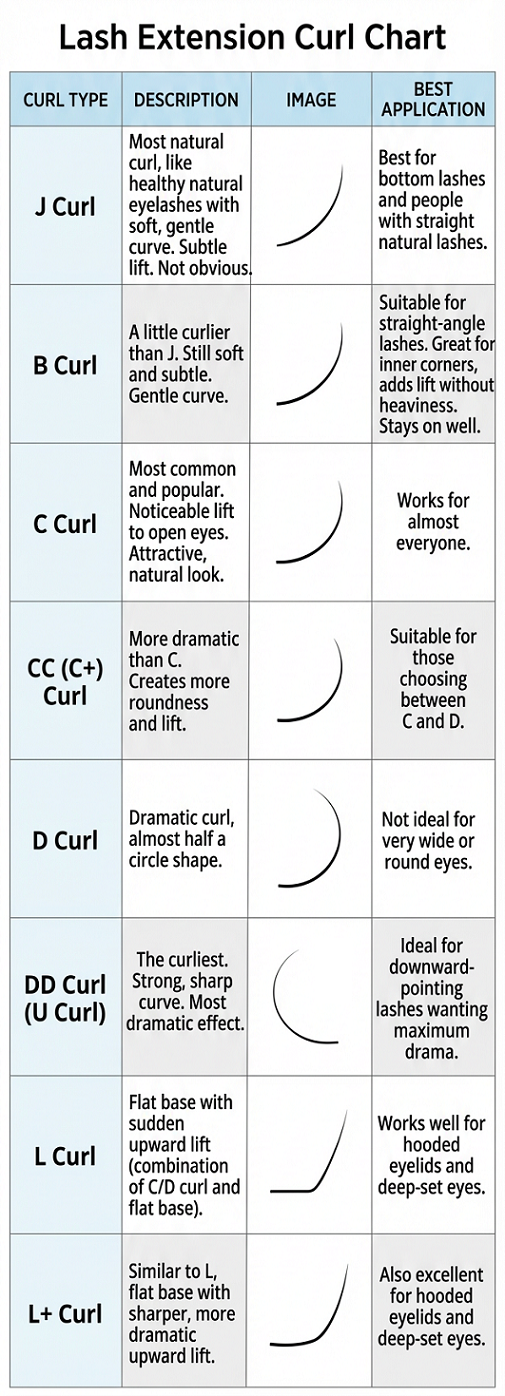
Natural lashes and lash extensions come in different shapes, determined by their curl direction and angle. Let’s learn about the common types of eyelash curls. Each curl type is represented by a specific letter.
J Curl: The most natural type of eyelash curl. It looks like real, healthy eyelashes, with a soft and gentle curve. It can lift your lashes a little, but it is not obvious. It is best for bottom lashes and people with straight natural lashes.
B Curl: A little curlier than J curl. It is still soft and subtle, suitable for people with straight-angle lashes. It is also great for the inner corners of the eyes, because it adds lift without making the eyes look too heavy. B Curl stays on well because of its gentle curve.
C Curl: One of the most common and popular eyelash curls, it has a noticeable lift that can open up your eyes, creating an attractive and natural look. It works for almost everyone.
CC (C+) Curl: A bit more dramatic, creates more roundness and lift than C curl, it is suitable for those who can’t choose between C and D.
D Curl: Dramatic curl, almost the shape of half a circle, it is not ideal for very wide and round eyes.
DD Curl (U Curl): The curliest one. It has a strong and sharp curve. It is ideal for people with downward-pointing lashes who want the most dramatic effect
L & L+ Curl: A flat base with a sudden upward lift, actually a combination of a C/D curl and a flat base. These types work well with hooded eyelids and deep-set eyes.
How to Choose the Best Lash Extension Curl?
Natural Lash Direction: If natural lashes point downward, a strong curl (like D or DD) is needed to lift them. If they’re straight, a softer curl (like B or C) will look more natural.
Eye Shape: Hooded or monolid eyes need curls with a flat base (like L or LC) to avoid the extensions touching the eyelid. Almond eyes can pull off almost any curl.
Desired Effect: Natural looks call for soft curls (J, B), while dramatic looks need strong curls (D, DD). Clients wanting a wide-eyed effect can choose L or M curls.
Retention: Curlier lashes (like D or DD) have less surface area to attach to natural lashes, so they may not last as long as straighter curls (like B or J). This is important to consider for clients who want long-lasting extensions.
Eyelash Extensions Thickness (Diameter) Chart
In addition to length, another important eyelash extension size is thickness. Lash extension thickness or diameter is the width of each extension, measured in millimeters (mm). It affects the look, weight, and safety of the extensions—thicker extensions are bolder and heavier, while thinner ones are softer and lighter. The majority of lash extensions range in thickness from 0.03 to 0.3mm, with 0.15mm being a popular choice.
| Thickness (mm) | Visual Effect | Best Application | Volume Type |
|---|---|---|---|
| 0.03 | Ultra-soft, fluffy, light, airy | Mega Volume, fine natural lashes, cloud-like effect | 8D–16D+ |
| 0.05 | Balanced density, natural definition | Most Volume styles, general salon use | 3D–8D |
| 0.07 | Denser, more defined, visible fan lines | Light Volume, Hybrid sets, stronger natural lashes | 2D–4D |
| 0.10 | Soft, clean, natural mascara look | Soft Classic, fine/average natural lashes | 1D (Classic only) |
| 0.12 | Noticeable definition, natural but clear | Standard Classic, most clients, daily use | 1D (Classic only) |
| 0.15 | Bold, dark, sharp lash line | Bold Classic, strong healthy, natural lashes | 1D (Classic only) |
| 0.18 | Very bold, dramatic, dense | Heavy Classic, stronger lashes; limited Volume | Max 6D (Volume) |
| 0.20 | Extremely bold, dark, thick | Heavy Classic, very strong, thick lashes; low-volume only | 2D–3D (small fans only) |
| 0.25–0.30 | Overly thick, super dramatic | NOT recommended– too heavy, risks lash damage | Not suitable (high risk) |
Key Factors for Choosing Eyelash Thickness
Natural Lash Strength: Thin, weak natural lashes can only handle thin extensions (0.03–0.07mm). Thick, strong natural lashes can handle thicker extensions (0.15–0.30mm). Using heavy extensions on weak lashes is one of the most common causes of lash damage.
Lash Volume Set Type: Classic sets (one extension per natural lash) use thicker extensions (0.10–0.20mm), while volume sets (multiple thin extensions per natural lash) use thinner extensions (0.03–0.07mm) to keep the weight light.
Desired Look: Thicker extensions create a bold, dark lash line (great for dramatic looks), while thinner extensions create a soft, fluffy look (great for natural or volume sets).
Handling Difficulty: Thinner extensions (0.03–0.05mm) are more delicate and require more skill to apply, while thicker extensions (0.10–0.15mm) are easier to handle (good for beginners).
Eyelash Extension Volume Styles
The different extension volume sets control density and fluffiness, from natural single lashes to ultra-voluminous textured styles.
1. Classic Eyelash Extensions
Classic lash extensions use a simple 1:1 application method—one single extension is glued to each natural lash. This style creates a soft, natural look that mimics the effect of nicely applied mascara, adding gentle length and definition without extreme fullness. It’s the most basic and affordable option, ideal for first-timers or anyone wanting an everyday, understated enhancement, and it works best for those with naturally dense, healthy lashes.
2. Volume Eyelash Extensions
Volume lashes use handmade lightweight fans of 2 to 6 ultra-fine extensions applied to one natural lash, delivering a fluffy, dense, and fuller appearance. Though they add significant volume, the thin individual extensions keep the overall weight gentle on natural lashes. This technique requires advanced skill and longer application time, offering customizable drama from subtle to bold, and is great for those wanting more dimension than classic lashes without going over-the-top.
3. Mega Volume Eyelash Extensions
Mega volume is the most intense version of volume lashes, using extra-thin extensions to form large fans of 6 to 15+ per natural lash for maximum density and bold drama. Designed for a striking, glamorous statement look, it demands highly skilled technicians and longer application times. Due to the heavy fan structure, it’s only suitable for people with strong, thick natural lashes and is often chosen for special occasions rather than daily wear.
4. Hybrid Eyelash Extensions
Hybrid lashes combine classic 1:1 extensions and small volume fans in one set, usually in a roughly 50:50 ratio. This creates a balanced, textured look that’s fuller than classic but softer and less dense than full volume. It’s the perfect middle ground for those who want more depth than classic lashes but aren’t ready for full volume, with moderate application time and cost.
Lash Extension Weight Chart & Conversion
The weight of an extension refers to how heavy a single lash extension is, measured in milligrams (mg). It is not the same as diameter (thickness), but it is related to the thickness. To ensure safety, you need to avoid too heavy extensions, as they will damage your natural lashes, make them fall out early, break, or become sparse. Generally speaking, the thicker an eyelash is, the heavier it becomes—though not necessarily twice as heavy. For example, one 0.2mm lash is heavier than two 0.1mm lashes. Below is a common lash extension weight chart.
| Diameter(mm) | Weight(mg) |
| 0.03 | 0.008 |
| 0.05 | 0.02 |
| 0.07 | 0.04 |
| 0.10 | 0.09 |
| 0.12 | 0.13 |
| 0.15 | 0.17 |
| 0.18 | 0.25 |
| 0.20 | 0.34 |
For people who want to convert classic lashes to volume sets, you need to know how many lashes to get for each set. Here are some fast lash extension weight conversion equations:
1x0.12mm classic lash = 17x0.03/5x0.05/3x0.07 mm volume lash
1x0.15mm classic lash = 20-25x0.03/8-9x0.05/4x0.07/2x0.1 mm volume lash
1x0.18mm classic lash = 31-36x0.03/12x0.05/6x0.07/3x0.1 mm volume lash
Eyelash Extensions vs. False Lashes: Which One to Choose?
To get long and full eyelashes, you can pick false eyelashes or lash extensions. Which one is better for you? Let's look at the differences between them and then make the decision.
What Are False Eyelashes
False or fake lashes are temporary options that can be installed or taken off at any time. You can use them for one day or for events. They can be made of synthetic, mink, silk, or other materials, and come in different shapes like strips, clusters, or single lashes.
Pros of Fake Lashes
Super convenient & DIY: You can apply them at home with glue and remove them easily at night.
Easy to find: Sold in drugstores, beauty shops, and online — great for last-minute plans.
Huge variety: Many lengths, styles, and materials for natural, glamorous, or fun looks.
Cheap & budget-friendly: Much less expensive than extensions.
Reusable: Can be worn 5–20+ times if cleaned and stored carefully.
Cons of Fake Lashes
Only lasts one day: Must reapply every time you wear them.
May fall off early: Wind, sweat, tears, or humidity can loosen the glue.
Hard for beginners: Takes practice to apply neatly; bad application feels uncomfortable.
Can damage real lashes: Rough removal or wrong glue can break or pull out your natural lashes.
What Are Eyelash Extensions
Lash extensions are semi‑permanent solutions, generally applied by a professional technician one by one onto your natural lashes.
Pros of Lash Extensions
Long-lasting: Stay on for 4–8 weeks; no daily application.
Waterproof & durable: Safe for showering, swimming, and sleeping.
Natural look: Blends with real lashes; no need for mascara.
Fully customizable: Length, curl, and thickness tailored to your eyes.
Saves time: Skip mascara, curling, and daily lash makeup.
Cons of Lash Extensions
Very expensive: High initial cost + refill appointments every 2–3 weeks.
Needs maintenance: Must get refills to avoid sparse, messy-looking lashes.
Allergy risk: Some people react to the strong glue.
Can damage natural lashes: Heavy extensions or bad application can weaken or pull out real lashes.
Choose false lashes if:
You’re on a budget.
You want changeable styles often.
You only want lashes for events, not every day.
You don’t want frequent salon appointments.
Choose lash extensions if:
You want perfect lashes every morning with zero effort.
You don’t mind spending money for long-term results.
You want the best natural look.
You hate daily makeup or wearing fake lashes.
You are one step away to access to our wholesale prices