

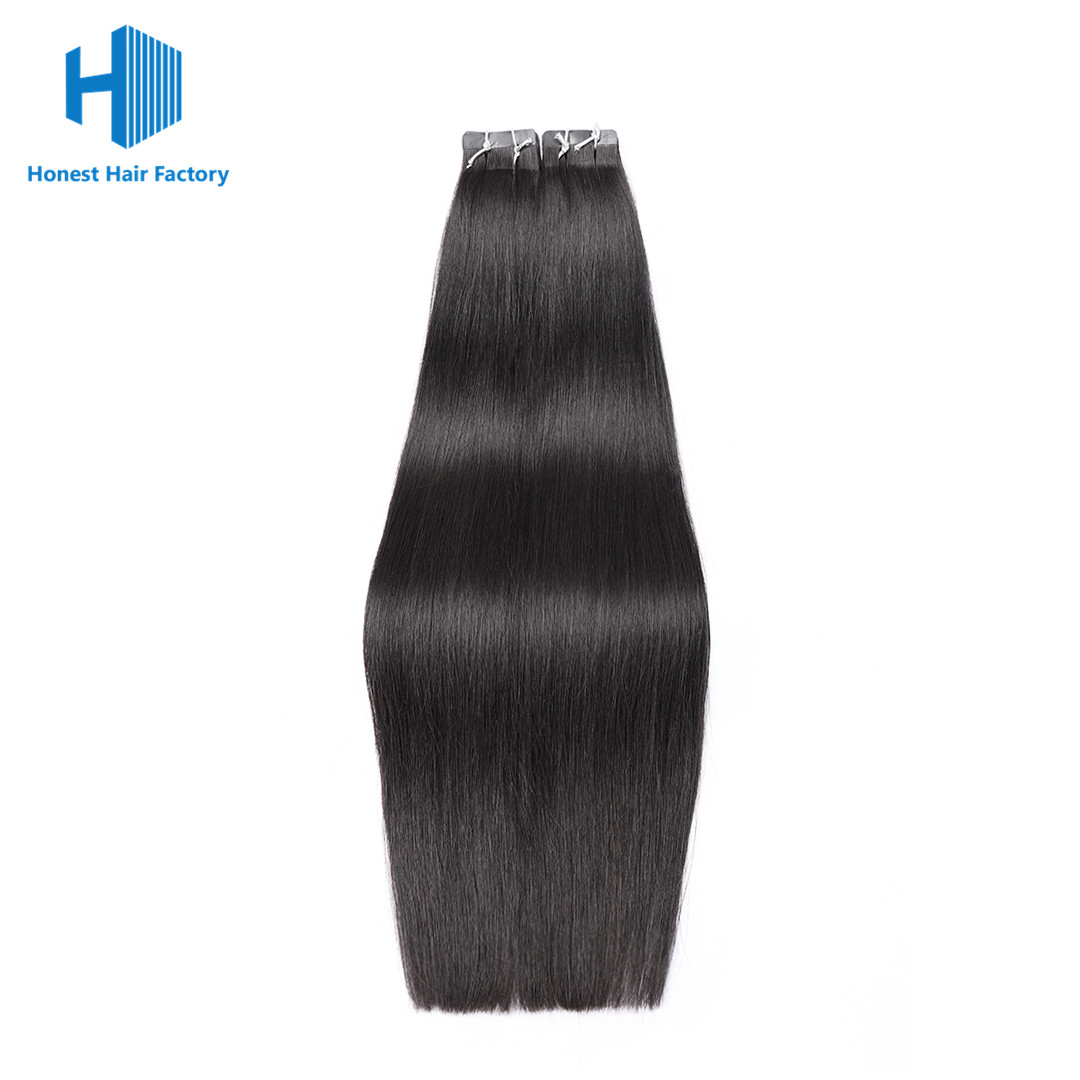
A widely available straight tape-in variant tailored for fine strands features 100% unprocessed virgin human hair with fully aligned cuticles, supplied in natural black shade with customizable lengths ranging from 12 to 30 inches.
Hair Texture Guide - Different Types of Hair Textures
Understanding your hair texture helps you choose products that are neither too heavy nor too light for your strands and provides insight into whether your hair is suitable for heat styling, chemical treatments, and extensions. In this article, we’ll focus on the hair texture definition, different hair textures (chart), comparison with hair types, and how to identify them.
What Is Hair Texture?
Hair texture refers to the physical thickness and diameter of a single individual hair strand (hair shaft), which is determined by the internal structural layers of the hair. It is a microscopic physical feature of hair strands, focusing on the tactile and structural properties of each separate hair fiber. Hair texture is fixed based on inherent hair shaft structure and is applicable to all hair curl patterns, meaning straight, wavy, curly, and coily hair can all possess fine, medium, or thick textures. Additionally, hair texture is distinct from hair density (the number of hair strands per unit scalp area) and hair porosity (the ability of hair to absorb moisture and products), though the three attributes interact to affect hair performance.
Hair Texture vs Hair Type
The two terms are frequently used interchangeably in daily life, but they describe completely different hair characteristics with essential differences in definition and research scope:
Hair type focuses on the natural curl pattern of the overall hair. It is a macroscopic morphological feature determined by hair follicle shape, cortical cell arrangement, and hair growth biology. Genetics serve as the main determinant, while long-term hormonal changes (such as pregnancy and thyroid fluctuations) can subtly adjust the tightness of curls or waves without completely altering the core hair type.
Hair texture focuses on the diameter and structural thickness of a single hair strand. It reflects the physical toughness, softness, and fragility of individual hair fibers, independent of the overall hair curl state.
For an intuitive example: A person may have Type 2A wavy hair (specific hair type) with a medium strand thickness (specific hair texture), which fully demonstrates the independent existence of the two attributes.
Different Hair Textures Classification
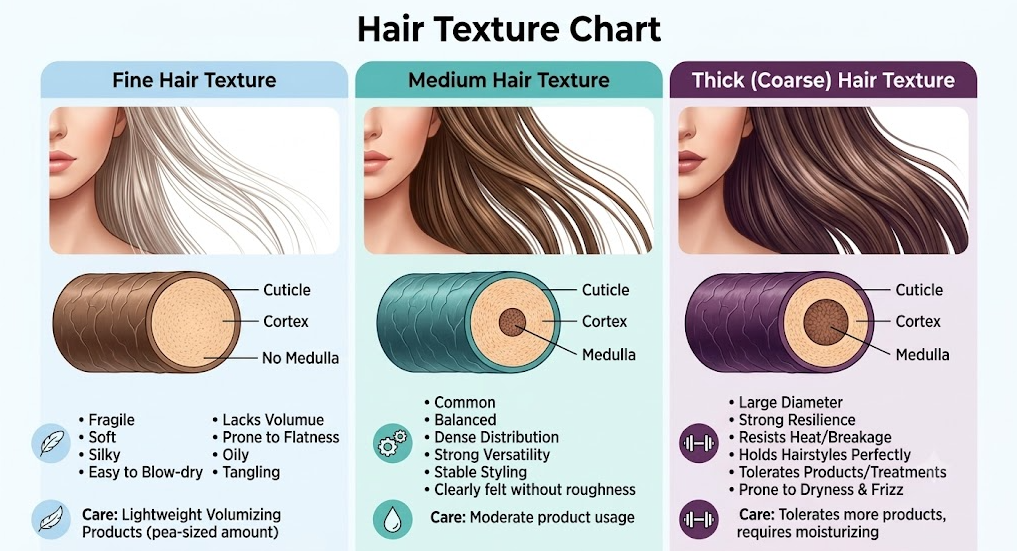
All hair strands fall into three texture categories based on shaft diameter and structural layers: fine, medium, and thick (coarse). Each hair texture has unique physical properties, fragility, and care requirements, unaffected by curl type.
Fine Hair Texture
Fine hair is the most fragile and softest texture, consisting of only two structural layers: cortex and cuticle (lacking the medulla). It is silky and delicate to the touch, easy to straighten and blow-dry, but prone to flatness, rapid oil accumulation, tangling, and breakage. It cannot hold hairstyles stably and is easily weighed down by excessive hair products. For care, a small, pea-sized amount of lightweight volumizing products is recommended to avoid grease buildup and flat hair.
Medium Hair Texture
As the most common and balanced hair texture, medium hair has a complete three-layer structure (cuticle, cortex, medulla). It features dense scalp distribution, strong styling versatility, and stable style retention. Tactilely, a single strand can be clearly felt without coarse roughness. It is less prone to breakage than fine hair but may dry out with improper care. Similar to fine hair, moderate product dosage is required to prevent residue buildup.
Thick (Coarse) Hair Texture
Thick (coarse) hair has the largest strand diameter and the strongest resilience, also with a three-layer shaft structure. It resists heat damage and breakage best, holds hairstyles perfectly, and tolerates more hair products and thermal treatments. However, it is the most prone to dryness and frizz among the three textures due to slow natural oil distribution. Tactilely, strands feel thick, firm, and slightly coarse, and hair products do not easily weigh them down.
Hair Texture Chart
Best Hair Extensions for Fine Hair
Fine hair features delicate, low-density strands that are prone to breakage, flatness, and tension damage. When selecting hair extensions for fine or thinning hair, the core principle is to choose lightweight, wide-coverage, low-tension installation methods that evenly disperse weight across the scalp, avoiding concentrated pressure on small sections of fragile natural hair. Properly fitted extensions are safe for fine hair and can effectively boost length and volume without causing long-term damage, while improper methods or unprofessional installation may lead to root strain, breakage, and unnatural blending.
Safest Extension Methods for Fine Hair: Tape-In Extensions
Tape-in extensions are the most recommended semi-permanent option for fine and thinning hair in professional salons. Each weft measures 30–40mm in width, distributing extension weight over a large natural hair section to avoid localized overloading, which solves the core stress problem of fine hair extensions. Medical-grade adhesive wefts are sandwiched above and below small, clean natural hair sections, forming a flat, scalp-flush attachment with no heat or metal tools required during the 90-minute installation process. The wefts are removable via a professional solution, reusable, and repositionable every 6–8 weeks before replacement.
How to Know Your Hair Texture?
Hair texture identification focuses on testing the thickness and tactile sense of single hair strands, with a simple, accurate home detection method applicable to all hair types and colors:
First, take 1–3 clean, dry hair strands and rub them gently between the forefinger and thumb. If the strand is barely perceptible with an ultra-soft, silky feel, it belongs to a fine texture. If the strand can be clearly felt with moderate thickness and no coarse texture, it is of medium texture. If the strand feels thick, firm, and slightly rough, it is thick (coarse) texture.
Auxiliary judgment can be made through hair performance: fine hair easily becomes flat and oily; medium hair maintains stable volume and state; thick hair is dry and frizz-prone but durable in styling. It is important to distinguish texture from density: dense hair does not equal thick hair texture, and misjudgment will lead to inappropriate hair care routines.
Different Hair Types (Curl Pattern)
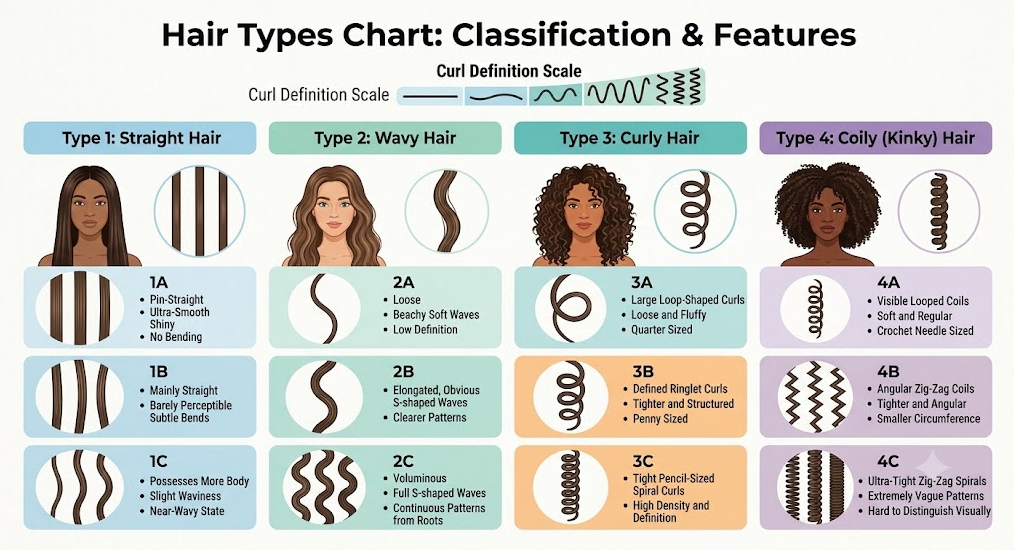
The mainstream Andre Walker 1A–4C classification system divides natural hair into four core types according to curl patterns, each with three subtypes (A, B, C) representing gradually tighter and more defined curl or wave patterns. This hair typing system is a practical heuristic for daily hair classification and communication, though it is not a rigorous clinical diagnostic standard, and many people have mixed hair types on different scalp areas.
Type 1: Straight Hair
Type 1 hair has no natural bends, waves, or curls, lying flat from root to tip. Its subtypes differ in hair volume and subtle bending degree:
1A: The straightest hair subtype, featuring pin-straight, ultra-smooth, and shiny strands with no slight bending at all.
1B: Mainly straight, with barely perceptible subtle bends observed upon close inspection, retaining overall flatness.
1C: Possesses more body and slight waviness than 1A and 1B, presenting a near-wavy state without complete wave formation.
Type 2: Wavy Hair
Type 2 hair forms natural S-shaped waves, with subtypes distinguished by wave definition, starting position, and volume:
2A: Features loose, beachy soft waves that usually start several inches away from the hair roots with low definition.
2B: Has elongated, obvious S-shaped waves with far clearer patterns than 2A waves.
2C: Boasts voluminous, full S-shaped waves that extend continuously from the roots to the hair ends with the strongest wave definition among Type 2 subtypes.
Type 3: Curly Hair
Type 3 hair forms bouncy ringlets and spiral curls, with subtype differences reflected in curl tightness and loop size:
3A: Large loop-shaped curls with a width approximately equal to a quarter, loose and fluffy.
3B: Defined ringlet curls sized roughly like a penny, tighter and more structured than 3A curls.
3C: Tight pencil-sized spiral curls, with higher density and definition than 3A and 3B curls.
Type 4: Coily (Kinky) Hair
Type 4 hair is characterized by extremely tight, compact coils or zigzag patterns, with high overall volume and obvious shrinkage. Its subtypes vary in curl shape and tightness:
4A: Visible looped coils with a circumference similar to a crochet needle, featuring soft and regular coil shapes.
4B: Angular zig-zag coils with a smaller circumference and a tighter structure than 4A coils, lacking obvious circular loops.
4C: Ultra-tight zig-zag spirals with extremely vague patterns that are hard to distinguish visually, representing the tightest hair subtype.
Hair Types Chart
How to Identify Your Hair Type?
Hair type identification targets the overall natural curl pattern, requiring product-free and interference-free detection to ensure accuracy, with standardized home operation steps:
Step 1: Prepare clean hair – Wash hair with conventional shampoo (avoid heavy conditioners and styling products) and let it air dry completely naturally to restore the original curl or wave state.
Step 2: Observe morphological features – Observe the overall hair shape in a mirror: flat and traceless is Type 1 straight hair; S-shaped waves are Type 2 wavy hair; bouncy ringlet spirals are Type 3 curly hair; tight zig-zag coils are Type 4 coily hair. Further confirm subtypes based on pattern tightness, size, and starting position.
Step 3: Combine auxiliary attributes – Assess hair density by parting hair to observe scalp visibility or using the ponytail circumference test (1–2 inches for low density, 2–3 inches for medium density, ≥4 inches for high density). Judge porosity by observing the absorption speed of hair products and hair’s response to humidity, to form a comprehensive hair type profile.
It is normal to have mixed hair types (e.g., 3A curls on the top of the head and 4B coils at the nape). The classification system is a guiding reference rather than an absolute standard, and chemical or thermal styling may also cause temporary pattern changes.
You are one step away to access to our wholesale prices