

What are Sew-In Hair Extensions? Sew-In Weaves Advantages, Disadvantages & Last Time
Sew in extensions or weft extensions are the classic extension system. And they are not the classic system by mere chance. For many years human hair sew in weaves has proven to be a reliable permanent extension system with a super strong hold. In addition, they also have the flexibility of being able to place them with different placement methods. If you are looking for extensions permanently and do not have to worry much about their maintenance or repositioning, human hair sew-in extensions are your best option.
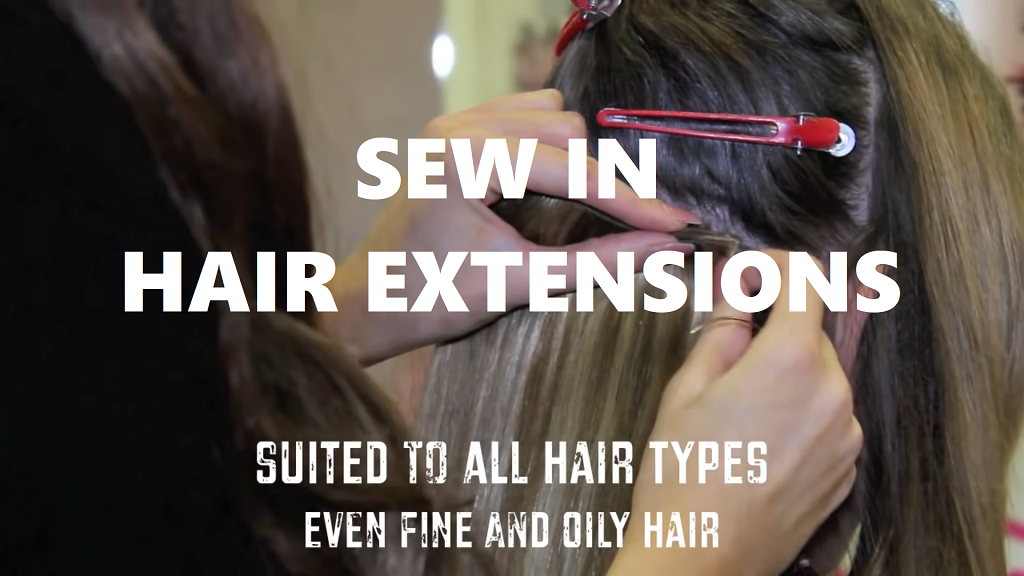
What are Sew-In Hair Extensions?
Sew in hair extensions are more weave extensions that are placed sewn to the hair itself instead of using staples, rings, or clips. This carries some advantages such as the fact that they are practically invisible and integrate perfectly with your own hair.
In this technique, natural hair is braided into a French braid or simply: line. Depending on the final model, they will be made from one line to several throughout the head. After making the braids, the extensions are sewn into the braids, depending on the desired look.
These types of hairpieces are designed especially for women with smooth, wavy, body, deep wave bundles or curly hair who want to increase the length and volume of their hair without damaging their own hair and scalp.
Sewn in hair extension can be used both with a fixed placement and converted into removable and put extensions through clips. There are two existing ways to fix them permanently:
1. Use rings that close with pressure and fix the hair of the extension to the natural.
2. By means of a braid at the root of the scalp to sew the curtain extensions using the braid as a base.
Who is Sew In Extensions Suitable For?
Sewn-in extensions from our hair & wig company are specially designed for women with straight, wavy, or curly hair who want to significantly increase the length and volume of their hair with minimal damage to their own hair and scalp.
If you have very straight hair, the smooth sew-in extensions of our straight virgin hair bundles are the most suitable for you; If you have wavy hair, your ideal extensions are the smooth ones of the body wave hair, loose wave, and deep wave virgin hair, since they can be undulated by applying foam and diffuser. And if your hair is curly choose between the curly curtain extensions of the curly line, for people with very curly hair and for artistic creations, or those of the kinky curly line, of soft and natural curls.
Advantages of Sew In Hair Extensions
Protect natural hair - The natural hair is hidden so that for a while it is protected from the environment and manipulations. It is therefore a protective style that will protect your hair. You can space out any chemical treatment: dye, permanent... etc, and even use it for a transition (from smoothing to natural)
They are quick to place - A bundle costs about 15 minutes. The whole head between an hour and a half and two hours. Few methods of laying extensions are achieved in such a short time.
Easy to remove - You just have to cut the thread with which you have sewn the hair to the braid and undo the braid. This process costs about half an hour if you haven't had the extensions for a long time.
They are easy to maintain - It does not require more than a little more patience to dry them than natural hair.
Do not affect or interfere with the texture of natural hair - Sew in extensions does not stick to the hair in any way, nor does it intermingle with natural hair.
Can be used to add hair in people with severe hair loss - People with little hair somewhere on the head can benefit from this mode of placement of the sewn in hair extensions, since this method does not necessarily require a lot of hair to be able to hold.
Used in combination with hair transplant surgery - It is usually used while the transplanted part of the hair is being filled.
The finish is natural - It can be used with both natural hair and synthetic hair.
Disadvantages of Sew In Hair Extensions
They can be uncomfortable to the touch - It is necessary to touch them up often so that they look perfect. Root braids can sometimes be felt as 'lumps'.
They take time to dry - Because they add volume to the hair and natural hair is braided, hair takes 50-100% longer to dry.
They can accumulate residues in the braid - There is a real difficulty of having the hair of the braid completely clean if they are not washed well and the sewn in extensions are not changed with the proper frequency grease, sweat, dirt, soap residue accumulates.
How Long the Sew In Hair Extensions Last?
Professionals recommend removing sewn in extensions every 6 weeks. At most, they can be left for 8 weeks, but no more, otherwise, it could affect the growth of your own hair.
Remember that after removing them you must let the scalp rest for a reasonable time before putting any type of hairpiece back on.
Sew In Hair Extensions Cost
The cost of sew-in hair extensions (also known as weaves) can vary widely based on several key factors, but you can generally expect a range from $200 to $1,500+ for the complete service (hair and installation). Here’s a detailed breakdown of what influences the price:
This is the most significant variable. Hair quality, type, and origin are the main price determinants.
Synthetic Hair: $20 - $100 per pack. Rarely used for sew-ins as it doesn't last or look as natural.
Basic Human Hair (Asian/Chinese): $50 - $150 per pack. Often processed, can be less durable, and may tangle more easily.
Virgin Human Hair (Unprocessed): $150 - $400+ per pack. Higher quality, lasts longer, and can be styled with heat. Common types include:
Brazilian: Dense, thick, and wavy/curly.
Peruvian: Soft, silky, and holds waves/curls well.
Malaysian: Very straight, silky, and heavy.
Indian: Versatile, often naturally wavy.
Remy Human Hair (Cuticle intact): $200 - $600+ per pack. The gold standard. The cuticles are aligned to prevent tangling, making it the most durable and natural-looking.
How much hair is needed? Typically 3-4 bundles for a full head, plus a closure (for the top) or a frontal (for a full hairline). Closures can cost $50-$200, frontals $100-$300+.
How to Sew In Hair Extensions for Beginners?
Doing a sew-in on yourself as a true beginner is very challenging and not recommended, as improper technique can cause hair loss (traction alopecia). It's best to watch a professional first. However, if you're determined to practice, here's a simplified overview. Wefted hair extensions, weaving thread (heavy-duty or polyester), curved weaving needle, rat-tail comb, hair clips, scissors, mannequin head (highly recommended for practice).
Basic Steps:
Prep & Part: Start with clean, detangled hair. Create a clean horizontal part where you want your first track. Clip the rest of the hair up and away.
Braid the Base (The Foundation): This is the most crucial step. Braid the section of hair below the part into a flat, neat cornrow that follows the part line. The braid must be snug but not painfully tight. The ends should be secured with a small rubber band or braided to the tip.
Prepare the Weft: Fold the end of the hair weft under about half an inch to create a clean, non-fraying start.
Start Sewing: Thread your curved needle. Place the folded end of the weft on top of the starting point of your cornrow. Use a "loop method": Push the needle through the weft and under the cornrow, then loop it back up and through the weft again to create a secure knot. Do this 2-3 times in the same spot.
Sew Along the Track: Use a simple "whip stitch" or "overcast stitch" to sew the weft onto the cornrow. Pass the needle through the weft fabric, then under the cornrow, pulling the thread snug (not tight) each time. Stitches should be about 1/4 to 1/2 inch apart.
Secure the End: When you reach the end, make 2-3 loop stitches in the same spot again. Tie off the thread with a double or triple knot and cut the excess.
Repeat: Create your next part above the first track, braid another cornrow, and sew the next weft on top, covering the previous track's braid. Continue until the desired area is covered.
Closure/Frontal: A closure (sewn onto a small braided square) or frontal (sewn onto a braided hairline) is used to cover the top/ front for a natural look.
Sew-In Hair Extensions for Black Hair
Protective Styling: A sew-in is a classic protective style. The key is ensuring your natural hair is healthy before installation. Deep condition and moisturize.
Braid Pattern & Tension: This is everything. Braids must be flat and neat but never too tight. Pain, bumps, and headaches mean it's too tight and can cause damage. Avoid excessive tension on the edges.
Leave-Out vs. No Leave-Out:
Leave-Out: A small section of your natural hair is left out to blend with the extensions. Requires daily styling and heat, which can lead to damage.
360 Frontal/Closure: No hair is left out. The entire head is braided, and a closure or frontal covers it. This is the ultimate protective style as all your hair is tucked away and requires no daily heat.
Hair Texture Match: Choose extensions that closely match the texture of your leave-out or desired style (e.g., kinky straight, curly, deep wave) for seamless blending.
How to Wash Sew-In Hair Extensions
Frequency: Every 2-3 weeks, or when you feel product buildup.
Goal: Clean the scalp and hair without loosening the braids.
Steps:
Dilute Your Shampoo: Mix a sulfate-free, moisturizing shampoo with water in an applicator bottle.
Apply to Scalp: Tilt your head back. Use the nozzle to apply the shampoo mixture directly along your part lines and braids. Do not pile hair on top of your head.
Gently Massage: Use the pads of your fingers (not nails) to massage your scalp along the braids.
Rinse Thoroughly: Tilt head back under the shower stream. Let water run through the tracks to rinse the shampoo from your scalp and the extension hair.
Condition: Apply a lightweight, leave-in conditioner or moisturizer mainly to the mids and ends of the extensions. Avoid heavy creams on the scalp/bonds. A light oil (like jojoba) can be applied to the scalp and braids for moisture.
Dry Completely: Gently squeeze out water with a microfiber towel. Air drying is best. If using a blow dryer, use a cool setting and a nozzle to dry the scalp thoroughly to prevent mildew. Ensure the hair and braids are 100% dry before styling.
How to Remove Sew-In Hair Extensions
Be Patient and Gentle.
What You Need: Sharp, small scissors (preferably thread snips), a tail comb, conditioner or detangling spray, a friend (helpful).
Steps:
Locate the Thread: Use the tail comb to find the thread used to sew the wefts.
Cut the Thread: Carefully insert the scissor tip under the thread only and snip it. Be absolutely sure you are only cutting the sewing thread and not your natural hair or the weft hair. Cut every 2-3 inches along the track.
Remove the Wefts: Once all threads are cut, the wefts should lift off easily. Gently pull them away from the braids.
Unbraid Your Cornrows: Spray each braid with conditioner, water, or a detangler. Gently and slowly unravel the braid with your fingers. Do not rip or pull.
Detangle & Wash: Once all braids are out, your hair will be curly and possibly matted. Do not use a comb yet. Apply more conditioner, finger detangle from ends to roots, then proceed with a gentle, clarifying wash and a deep conditioning treatment.
How to Tighten Sew-In Hair Extensions at Home?
When to Tighten: If tracks become slightly loose (you can feel them lift) but the braids underneath are still intact and healthy. If the braids are fuzzy, itchy, or your scalp is sore, it's time for a full removal.
What You Need: Curved needle, weaving thread (matching color), hair clips.
Steps:
Isolate the Loose Section: Clip away the surrounding hair to expose only the loose track.
Thread the Needle: Use a strong, double-threaded needle.
Re-Sew the Loose Area: Start sewing about an inch before the loose area. Re-attach the existing weft to the existing cornrow using the same whip stitch. Sew through the original holes in the weft if possible. Ensure you are sewing onto the braid, not your scalp.
Secure the End: Once you've sewn past the loose section, make a few lock stitches and knot securely.
Blend: Style the hair to cover the worked-on area.
Major Warning: Only attempt this for minor tightening. If more than one track is loose or the braids are compromised, see a professional. Repeated at-home tightening on old braids can cause severe matting and damage.
Why Wholesale100% virgin hair extensions from Honest Hair Factory?
1) Free of entanglement
2) No frizz
3) Thick at the tips
4) 100% human
5) It can be dyed, ironed, curled as it is 100% human hair.
6) Double cooked up for more protection of the strands at the time of ironing
We are a team dedicated to the production, distribution, and sale of hair extensions. We comply with the highest quality standards required by today's women. Our hair products are made of 100% human hair quality. Honest Hair Factory’s hair bundles can be dyed and washed without damaging the quality. The hair is selected from one head to keep the cuticle in one direction and not tangle when the hair is in contact with water. Using our virgin hair extensions. Hair will always remain radiant, tangle-free, smooth, and frizz-free. The hair is selected from one head to keep the cuticle in one direction and not tangle when the hair comes into contact with water.