

Genius weft is a type of hair extension that combines lots of advantages of other types. Should you choose genius wefts or not? This guide explains what the genius weft extension is, how long it lasts, how to install it, how much it costs, and which one you should buy when comparing it to hand-tied, machine, and butterfly wefts.
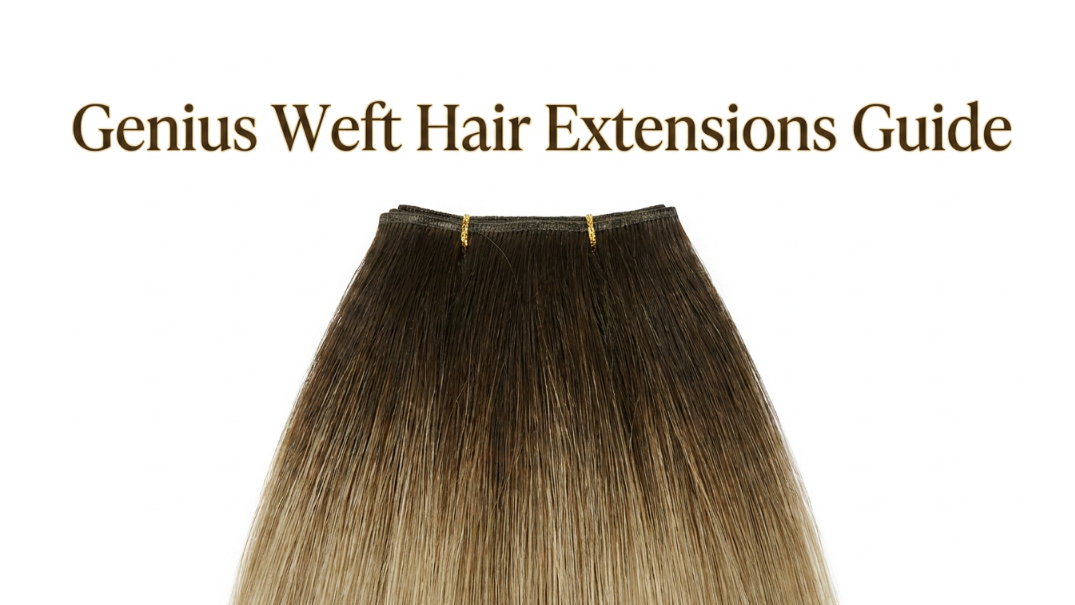
What Are Genius Weft Hair Extensions?
First, what does weft mean? A weft is a strip of hair extensions where many hairs are attached along a seam or track. The stylist installs it onto your natural hair using methods like beads + sewing, braids + sewing, or other professional techniques. Genius weft extension is still a weft — but with a newer construction. The main difference between weft hair extensions is in the construction of the base, which affects the thickness, flatness, durability, trimmability, and installation method of the hair pieces.
Genius weft hair extension is made by machine using a precision-sewn spine (typically uses bonded polyester thread), with a higher stitching density than that of hand-woven wefts, and finished to be as thin as hand-tied. The seam sits flat against your scalp, and the top edge is smooth with no return hair poking out. Another benefit is that genius wefts have a cuttable track that can be trimmed to fit without falling apart.
Key Characteristics of Genius Wefts
Ultra-thin seam (0.5mm to 1mm) — About half the thickness of regular machine wefts (which run 1.5-3mm). You won’t feel a ridge when you run your hand through the hair. The thinner seam means less bulk at the root and easier blending, especially on fine hair.
No return hair — Hand-tied wefts have short hairs folded back at the base. They itch and feel scratchy. Genius Weft minimizes or eliminates these, so it won’t poke your scalp.
Cut it anywhere — The weft track is sealed. If you need a 3-inch piece, cut it at 3 inches. It won’t shed or unravel. Hand-tied wefts can’t do this.
Light but structurally stable — It’s thin, but the higher stitch density makes the spine strong. With normal wear, the weft itself won’t break down before the hair does.
Lays flat — The track bends with your head shape. It doesn’t stick out or create a ridge.
For clients who want volume, this works well. For complete transformations, you can pair it with a closure or frontal to get a full, natural-looking result without any visible tracks.
How Long Do Genius Weft Extensions Last?
Genius weft hair extensions can last 8 to 12 months with normal care. That’s what most clients get. But the range is real. We’ve seen clients hit 18 months with careful maintenance. We’ve also seen people ruin a set in 4 months by sleeping with wet hair and yanking through tangles with a regular brush.
Three things decide where you land: the hair quality, the install, and your daily habits.
Each install stays put for 6-8 weeks (beaded) or 8-12 weeks (sewn-in) before you need a move-up. The 8-12 month figure is the full run of those re-installs, not one sitting.
Approximate Lifespan of Different Types of Hair Extensions
| Type | How Long Does It Last | Can You Reuse It? |
|---|---|---|
| Genius Weft | 8-18 months | Yes |
| Machine Weft | 12 months+ | Yes |
| Hand Tied Weft | 4-12 months | Yes |
| Keratin Tips | 3-4 months | No |
| Tape-In | 6-12 months (6-8 weeks per application) | Yes |
| Clip-In | 6-12 months | Yes |
Genius weft lasts about as long as machine weft. Because they both have sealed tracks that can hold the hair well. For retail hair stores and hair business starters, we offer the most cost-effective and quality hair sources. Our wholesale double-weft raw human hair extensions are available at the most affordable prices and can last up to 5+ years with proper use and care.
What Affects the Longevity of Hair Extensions?
Hair quality. This is the biggest factor. 100% Remy human hair with aligned cuticles holds up. Non-Remy or synthetic blends break down faster.
Installation. Sewn-in extension outlasts the beaded. Beaded outlasts clip-ins for daily wear. A good install is the foundation. A bad one fails no matter how good the hair is.
Maintenance. Brush gently, twice a day. Wash every 15-20 wears. Don’t skip the 6-week move-up. The clients who reach 12+ months are the ones who show up for adjustments.
Styling. Keep tools under 350°F (180°C). Use heat protectant. Bleaching will cut the lifespan, sometimes by half.
Sleep. Braiding is a good way to protect your hair weave. A silk pillowcase is recommended, and never sleep with it wet.
Genius Weft vs Hand Tied vs Machine Weft: Differences & Choices
If you’re trying to decide between these three popular types of weft hair extensions, here’s a straight comparison.
| Feature | Genius Weft | Hand Tied | Machine Weft |
|---|---|---|---|
| Thickness | 0.5-1mm (thinnest) | 0.7-1.2mm (thin) | 1.5-3mm (thicker) |
| Return Hair | None | Yes (can itch) | None |
| Can You Cut It? | Yes | No | Yes |
| Natural Look | Invisible when installed | Very natural | More visible |
| Durability | High | Medium | Very high |
| Comfort | Best | Good | Okay |
| Price | Mid-range | Expensive | Budget-friendly |
| Best For | Fine hair, sensitive scalps | Fine hair, natural look | Thick hair, volume |
Genius Weft vs Hand Tied Weft Hair Extensions
The main differences between hand-tied and genius weft extensions are cuttability and comfort.
Advantages of genius wefts
Both of them are thin and look natural. But hand-tied wefts have a weakness: if you cut them, they shed. The threads that hold the hair in place run the whole length of the weft. Cut it, and those threads come loose. Genius weft doesn’t have this problem. The track is sealed; you can cut it at any point, so it is easier to customize for tricky head shapes and better for sensitive scalps.
Advantages of hand-tied wefts
The core advantages of hand-tied extensions are that they are slightly less dense, which helps with color blending on some hair types, and they move naturally on certain hair textures. In addition, many stylists are trained on this method already.
For most clients, Genius weft extension is the more practical choice. Hand-tied works for thin hair, but you’ll be back in the salon more often for adjustments and repairs.
Genius Weft vs Machine Weft Hair Extensions
The main differences between genius wefts and machine wefts are thickness and natural appearance.
Who should go for machine wefts?
Machine wefts are built like tanks. They’re thick, heavy, durable, and cheap. Great for clients with medium to thick hair who want more volume. They can hold up to daily heat styling. For clients with fine hair who want a fuller look or maximum density, you can also wear machine wefts, but choose a proper installation method. Our factory-direct hand-tied and machine weft hair lines deliver reliable thickness, minimal shedding, and long-lasting wear for all hair textures and sizes.
When to pick genius wefts?
Genius weft extensions are thin and nearly invisible, and also light for all-day comfort. Pick them when you have fine or thin hair, you have a sensitive scalp, you want an invisible track, or you have a head shape that’s hard to fit.
Genius Weft vs Butterfly Weft: What Are the Differences
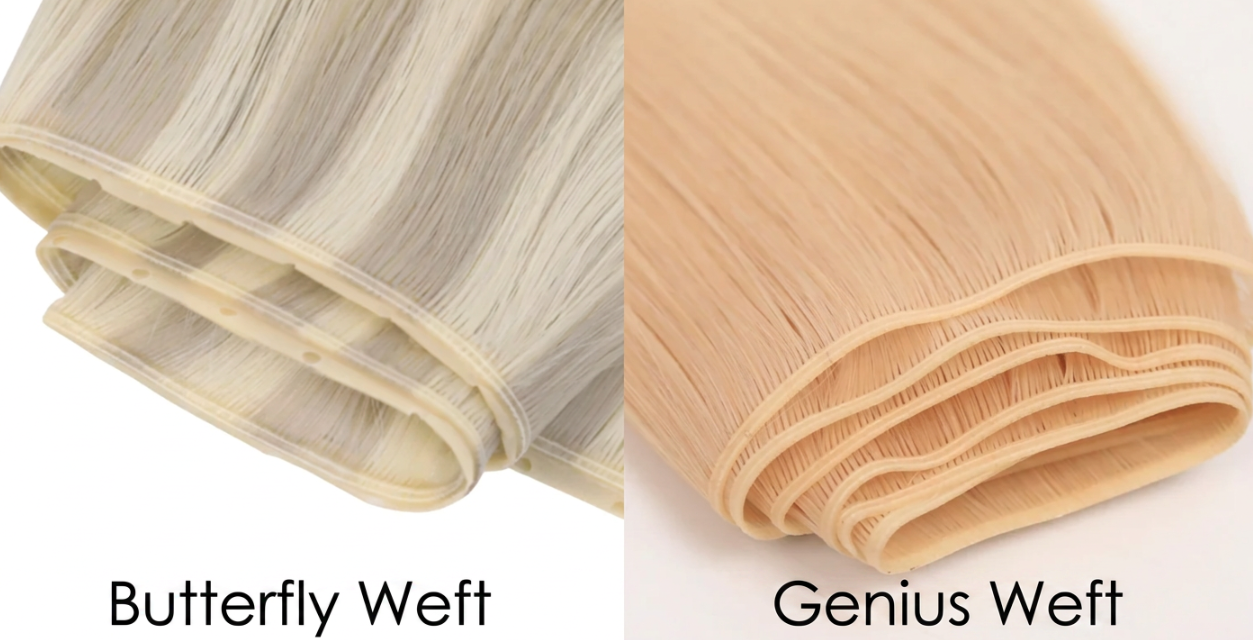
Butterfly weft hair extension is essentially a flat weft with pre-punched holes built in. You thread microbeads through those holes to anchor it — no sewing, no glue. The whole thing flips over once installed, so the beads disappear underneath. A skilled stylist can finish in about 15 minutes. The pre-punched holes make it almost plug-and-play with microbeads, one of the fastest semi-permanent extension installation methods.
Genius weft hair extension is a wider, cuttable weft. The base of the genius wefts is sealed — no holes, no beads included. The big selling point: you can cut it anywhere without it falling apart. Installation is slower — a salon pro needs 2-3 hours. It’s sewn or beaded into place, and the thin track sits flat against the scalp.
How to Install Genius Weft Extensions?
The install matters as much as the product. A bad install will make any weft uncomfortable and shorten its lifespan. Genius weft hair extension installs over a micro-bead foundation. The weft is then either sewn onto the foundation (most common) or held by beads alone.
Method 1: Beaded Foundation + Sew-In
This is the standard salon method. Two versions exist:
Standard Row — beads stay visible
Hidden Row — beads flipped under the weft, fully hidden
Both follow the same steps. The only difference is whether you flip the beads at the end.
Tools:
Silicone-lined micro-beads (matched to root color)
Looper tool
Pliers
Sectioning clips
Hair clips (to hold weft in place)
Curved needle + double thread
Genius Weft pieces
Step 1 — Section the hair
Work horizontally, row by row. A typical install ends around the third row from the nape. Each section is about thumb-width, with roughly 1/4 inch dropped between rows.
Step 2 — Build the beaded foundation
Start at the middle of the row (either end works).
Use the looper tool to pull a small strand of natural hair through the loop.
Slide a micro-bead onto that strand. Match the bead to the client’s root color.
Clamp with pliers — squeeze middle, top, bottom (3 squeezes) until silicone shows on both sides. This locks the bead.
Set the bead slightly off the scalp, not flush. This allows natural movement and prevents tightness.
Keep strands clean and parallel. No crossed hairs. Work at eye level.
Continue around the head, angling up as the row curves.
Step 3 — Stack the weft
Line the first weft piece up with the foundation.
Clip it down to hold. Keep the weft taut — no ripples.
Pin through the pocket of hair, then onto the weft, to lock it.
Add the next layer, lined up with the first.
Layer count: low density = 2, medium = 3, thick = 4.
Step 4 — Sew the weft down
Double-thread the needle. Triple knot at the end.
Start at the third pocket (each bead has a pocket on each side).
Drop the needle through the pocket, catching both weft layers.
Blanket-stitch through each pocket (right and left of every bead).
Add one stitch under the weft between pockets to hold layers together.
At each end, do extra anchor stitches. Wrap the thread once around the needle for a mini knot.
Keep stitches snug, never tight. Tension causes pain and shedding.
Finish with a triple knot. Cut the thread.
Step 5 — For Hidden Row only
After Step 2, before stacking, flip the beads up so they sit under the weft. Then continue with Steps 3-4. This hides the beads completely. Takes longer than standard row.
Step 6 — Move-up and care
Every 4-6 weeks: unclamp the bead, comb out shed hair, push the bead up.
Every 10 weeks (or if skipping move-ups): full reinstall with the same hair.
Brush gently twice a day. Wash every 15-20 wears.
Method 2: Beaded Only (No Sewing)
Some stylists attach Genius Weft using micro-beads alone. The weft is clipped to the beaded foundation, and the beads are clamped to hold it, with no stitching. This is faster but less secure than the sewn method. Suitability depends on hair density and activity level.
How Long Does an Install Take?
A full head of Genius weft takes 1-2 hours. Hand-tied wefts can take 2-5 hours because you have to work around the no-cut limitation. Genius Weft’s ability to be cut anywhere speeds up the process.
How to Make Genius Weft Last Longer?
Treat it right, and you’ll get 12 months or more. Treat it poorly, and you’ll be replacing it in 4-6 months.
Daily Care
Brush twice a day. Use a loop brush or extension-safe brush. Start at the ends and work up. Don’t yank near the track.
- Don’t sleep with wet hair. Dry it first. Braid it loosely. Use a silk or satin pillowcase.
- Protect it during workouts and swimming. Tie it up for exercise. Wear a swim cap in the pool. Apply UV protectant if you’re in the sun a lot.
Washing
How often: Every 15-20 wears, or every 2-3 weeks.
The process:
- Detangle before you wash.
- Use sulfate-free shampoo. Alterna Caviar Anti-Aging Shampoo works well. So do most extension-safe professional brands.
- Wash horizontally—move your hands side to side, not up and down. Scrubbing vertically creates tangles.
- Condition from mid-lengths to ends. Keep conditioner off the weft track.
- Rinse thoroughly. Get all the product out, especially between rows.
- Squeeze out water gently. Don’t rub or wring.
- Air dry when possible. If you blow-dry, use low heat and a heat protectant.
Styling Rules
Do:
- Use heat protectant before hot tools
- Keep tools at or below 350°F (180°C)
- Brush before and after styling
- Use products formulated for extensions
Don’t:
- Apply heat directly to the track
- Use sulfates, alcohol, or harsh chemicals
- Pull or tug on the weft while styling
- Sleep with clips, pins, or accessories in your hair
Salon Visits
Every 6-8 weeks: Book an adjustment. Your stylist will check the weft condition and move it up as your natural hair grows.
- Every 3-4 months: Deep conditioning treatment. Professional inspection for wear. Replace any pieces that are thinning.
Signs It’s Time to Replace
Excessive shedding at the weft
- Ends are visibly thinner than the roots
- The track is loose or damaged
- Texture has changed (feels rough, won’t hold style)
Color has faded beyond what a toner can fix
What Hair Extensions Last the Longest?
Many clients are wondering which type of extensions can last the longest, which is a complicated question. The answer is determined by lots of factors, including hair material quality, manufacturing technology, application, maintenance, etc. Typically, semi-permanent weft hair extensions, such as machine wefts and genius wefts, have a longer lifespan; they also come with a higher price and higher installation difficulty to ensure the final effect.
Can Genius Weft Hair Extensions Be Dyed?
Yes, but carefully. Be sure to:
- Use demi-permanent color on damp hair
- Test a strand first—extensions take color differently than natural hair
- Don’t bleach or lighten. It damages the hair.
- Permanent color is not recommended
- All coloring is at your own risk
How Much Does Genius Weft Cost?
Compared to other types, the price of genius weft extensions is in the mid-to-premium range.
- Retail: $80-$300+ per bundle (depends on length and quality)
- Premium lines: Up to $1000+ for luxury grade
- Wholesale: $70-$150+ per bundle
Is Genius Weft Right for You?
If you want extensions that are comfortable, invisible, and long-lasting, Genius weft is worth the investment. It solves the main problems with traditional wefts—itching, bulk, and the inability to cut them to size. The 8-18 month lifespan is real if you take care of it. But you need a good stylist for the install, and you need to show up for maintenance. If you have fine hair or a sensitive scalp, this is probably your best option. If you want maximum volume on a budget, machine weft might be the better call.
About Honest Hair Factory: We’ve been supplying premium weft hair extensions to salons and clients worldwide for years. Browse our hair bundles collection, or check out our wigs and closures for complete looks. Questions? Contact us—we’ll help you figure out what works for your hair.