

What Are K-Tip Hair Extensions - Keratin Tip Extensions Pros, Cons, Installation & Comparison
K-Tip extensions are one of the most popular long-term hair enhancement options for people who want to add hair length and volume naturally. Here is everything you need to know before getting keratin-bonded extensions, from how they work to how they are installed to how they compare to other types of extensions.
What Are K-Tip Hair Extensions? Flat Keratin Tip Explained
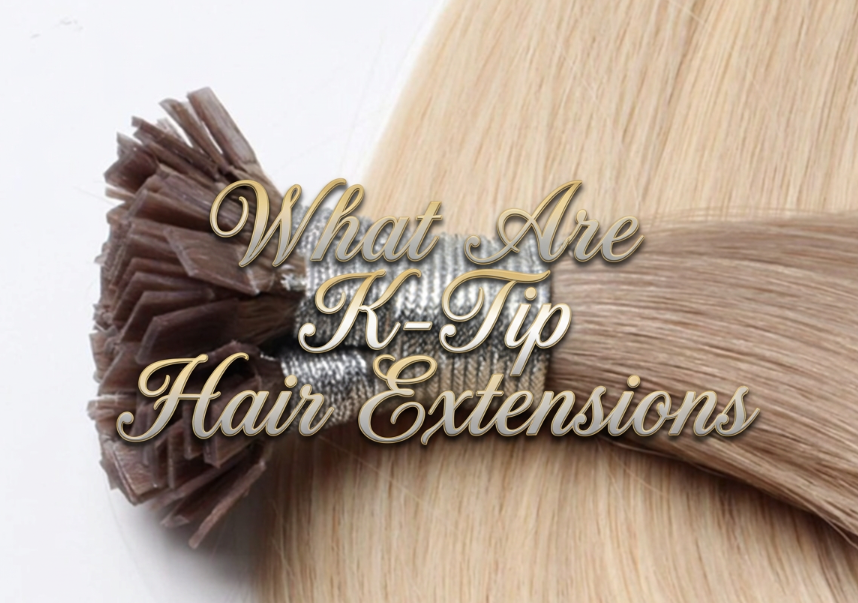
K-Tip extensions, also called Keratin Tip or Flat Tip hair extensions, are individual strands of hair with a flat, rectangular keratin tip at the top. The “K” stands for keratin, the same natural protein that makes up your hair, skin, and nails. Using a specialized heating tool, a stylist melts that keratin tip and bonds it around a small section of your natural hair close to the root. As the keratin cools, it hardens into a firm, flat seal that holds the extension securely in place.
What makes K-Tips different from other fusion hair extensions is the flat shape of the keratin tip. Traditional round bonds (like I-Tips or U-Tips) create a cylindrical attachment point that you can feel and sometimes see. The flat tip, by contrast, presses thin and wide against the natural hair, sitting almost flush with the scalp. This gives K-Tips an invisible appearance of hair pieces on the market. When you run your fingers through your hair, there is no bump. When you pull your hair up, there is nothing to expose.
Because each strand is attached individually, K-Tips move and flow exactly like your own hair. The keratin bond is flexible rather than rigid, so the extension sways naturally with your hair’s growth pattern. The result is a connection that looks and feels real, no clips, no tape, no visible seams.
Keratin-Tip Hair Extensions Pros and Cons
Advantages of K-Tip Extensions
Seamless, Natural Look: Since every strand is placed one by one, K-Tips blend flawlessly with your natural hair. The flat bonds are virtually undetectable — even in fine or thin hair where other methods might show. You can wear high ponytails, sleek buns, or intricate braids without worrying about anyone spotting the attachment points.
Long-Lasting Results: With proper care, K-Tips typically stay in place for 3 to 6 months. Some high-quality installations can last even longer, up to 12 months under ideal conditions. That kind of longevity is a major advantage over methods like tape-ins or clip-ins, which require far more frequent replacement.
Versatile Styling Freedom: K-Tips give you 360-degree styling freedom. Wear your hair up, down, curled, straightened, braided, or in a messy bun — the bonds stay hidden no matter what. The flexible keratin moves with you, not against you.
Lightweight and Comfortable: The flat keratin bond is small and flexible, so you will not feel heaviness or bulk. When properly density-matched (meaning the thickness of the extension matches the section of natural hair it is bonded to), K-Tips feel like nothing is there at all — just your own hair, but thicker and longer.
Durability: K-Tip bonds hold up well under normal styling conditions. You can use curling irons, flat irons, and blow dryers (just avoid direct heat on the bonds themselves). The keratin is designed to stay secure through washing, exercising, and everyday wear.
Low Maintenance Between Visits: Once installed, K-Tips do not require regular “move-up” appointments the way many other extension types do. The bonds stay put as your hair grows. Daily brushing, proper washing, and a few simple habits are all it takes to keep them looking great.
Customizable Volume: Because each strand is placed individually, you and your stylist control exactly how much volume or length you add. Whether you want subtle thickness or dramatic length, K-Tips can be tailored to your goals.
Disadvantages of K-Tip Extensions
Time-Consuming Application: Applying K-Tips is a meticulous, strand-by-strand process. A full head typically takes 2 to 4 hours, depending on the number of strands and the stylist’s speed. This is not a lunch-break appointment.
Potential for Damage: Like any extension method that involves heat and added weight, K-Tips carry some risk. The heat used to melt the keratin can weaken natural hair if the temperature is not carefully controlled. The weight of the extensions can also put stress on fine or fragile strands, potentially leading to breakage or thinning over time. Proper application and removal by a trained professional are essential for minimizing damage.
Higher Cost: K-Tips are among the more expensive extension methods. A full head typically costs between $300 and $1,500, depending on hair quality, length, and the stylist’s expertise. The initial investment is significant, and because the extensions are generally not reusable, you will need to purchase new hair for each installation.
Limited Reusability: Most K-Tip extensions cannot be reused once the keratin bonds have been removed. Some high-quality hair can be re-tipped by a professional (a new keratin tip is applied to the old extension), but this is not always possible and adds to the overall cost.
Not Ideal for Frequent Swimmers: Chlorine and salt water can break down keratin bonds over time. If you spend a lot of time in the pool or ocean, K-Tips may not be the best choice.
How Long Do K-Tip Extensions Last? Lifespan, Care & When to Replace
On average, K-Tip extensions last 3 to 6 months, with some installations reaching up to 12 months under ideal conditions. Several factors influence longevity:
Hair growth rate— As your natural hair grows, the bonds move further from the scalp. Once they get too far down the hair shaft, the extensions become more visible and less secure.
Care routine— Gentle washing, regular brushing with a soft-bristle brush, avoiding oil-based products near the bonds, and sleeping with hair in a loose braid all extend wear time.
Hair quality— High-quality human hair holds up better over months of styling and washing.
Lifestyle— Frequent heat styling, swimming, or exposure to harsh elements shortens the lifespan.
So, how often should your K-tip hair extensions be replaced? Considering the lifespan of the extension, schedule a maintenance check around the 4-month mark. If the bonds have moved too far from the scalp or the hair quality has declined, it is time for a full removal and reinstallation. If you choose to re-tip (applying new keratin to the existing extension hair), this can sometimes extend the life of the hair itself, but it is an additional service that not all stylists offer.
K-Tip Extensions Installation: Step-by-Step Process
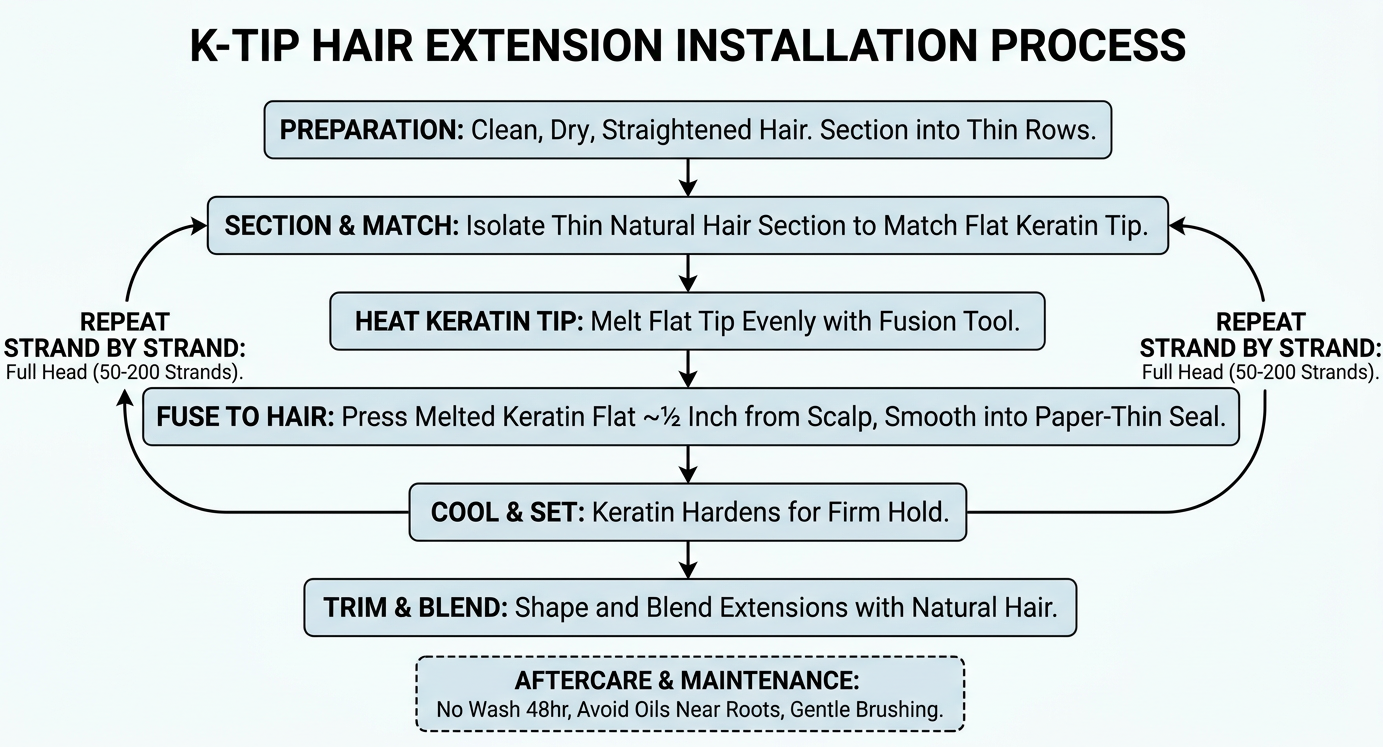
K-Tip installation is a professional procedure that should always be performed by a licensed stylist experienced with this method. Attempting it at home increases the risk of improper bonding, uneven placement, and damage to your natural hair.
Preparation
1. Start with clean, dry, straightened hair. Wash and blow-dry your hair thoroughly before the appointment. Any product buildup, oils, or moisture can interfere with the bond.
2. Section the hair. The stylist divides your hair into precise, thin sections — usually 6 to 8 rows in the back and 4 to 6 in the front. A leave-out section around the hairline and part is preserved to cover the bonds.
Step-by-Step Bonding Process
1. Sectioning— The stylist isolates a thin section of natural hair, roughly the same width as the flat keratin tip. Density matching is critical here: the extension should not be thicker or thinner than the section of natural hair it bonds to.
2. Heating the keratin tip— The fusion heat tool is applied to the flat keratin tip. Because of its flat shape, the keratin melts quickly and evenly, spreading thin rather than pooling into a ball.
3. Fusing to natural hair— The melted keratin is pressed flat around the section of natural hair, about half an inch from the scalp. The stylist smooths the bond flat — not round — creating a wide, paper-thin seal that lies invisible against the head. Leaving a small gap from the root ensures flexibility and prevents the bond from pulling on the scalp.
4. Cooling and setting— The keratin cools in seconds and hardens into a firm, flat, secure hold. Once set, the bond will not move or slip during normal daily wear.
5. Repeat strand by strand— The process is repeated for every strand. A full head typically requires 50 to 200 strands, depending on the desired volume and length.
6. Trimming and blending— After all bonds are placed, the stylist trims and shapes the extensions to blend seamlessly with your natural hair.
Aftercare Right After Installation
Do not wash your hair for 48 hours to allow the bonds to fully set.
Avoid heavy oils, conditioners, or silicone-based products near the roots — these can weaken the bonds.
Use a soft-bristle brush and detangle gently from the ends upward.
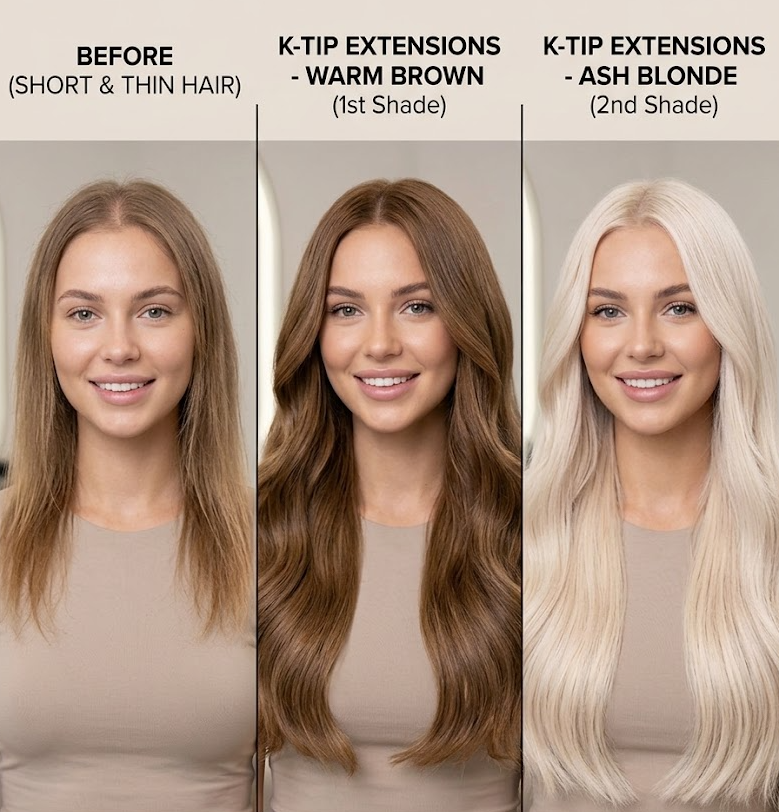
K-Tip Hair Extensions Before & After
One of the most common questions before buying K-Tip extensions: “What will I actually look like?”The answer depends entirely on your starting point — your natural hair length, thickness, and the number of strands you choose.
Every extension application adds two things:
Volume— How much thicker your hair looks from root to tip
Length— How many inches are added from the root to the end
These two dimensions work together. A high-volume, low-length application gives you a completely different look than a low-volume, high-length application. Knowing which you prioritize — or targeting both — shapes everything from strand count to budget.
Before & After by Transformation Level
| Goal | Strands Needed | Length Added | Natural Hair Requirement | Realistic Result |
|---|---|---|---|---|
| Subtle volume boost | 50–80 strands | Same length | Any length, medium+ density preferred | Fuller ponytail, thicker braids, no length change — most natural-looking option |
| Volume + shoulder-length | 80–120 strands | +4–6 inches | At least chin-length natural hair | Noticeably thicker with light length extension; ideal for shoulder-length styles |
| Full transformation | 120–150 strands | +8–12 inches | At least bob-length natural hair | Dramatic change — visible length and significant volume, versatile styling |
| Maximum luxury | 150–200+ strands | +12–16 inches | At least shoulder-length natural hair | Celebrity-level fullness; best results on medium-thick natural hair |
Realistic Expectations by Starting Hair Type
1. Fine hair (low natural density)
Volume-only install (50–80 strands) → Natural, seamless
Volume + length (80–120 strands) → Beautiful, but requires skilled blending
Maximum (120+ strands) → Possible with density matching, but requires an experienced stylist
2. Medium-density hair
Most versatile starting point
All four levels achievable
80–120 strands is the sweet spot for most clients
3. Thick/coarse hair
Fewer than 100 strands may not show a noticeable difference
Start at 120+ strands for visible results
Coarse texture actually makes bonds easier to conceal
4. Short natural hair (pixie to chin-length)
Extensions can add length, but the application is more complex
A skilled stylist may need to use a combination method (some K-Tips + a closure or frontal piece) for seamless blending at very short lengths
K-Tip Extensions Before and After Picture
Volume vs. Length: Which Should You Prioritize?
This is the #1 decision point in any K-Tip consultation. Here’s a quick framework:
| Choose VOLUME if… | Choose LENGTH if… |
|---|---|
| You have thin or fine hair | Your natural hair is already thick but short |
| Your ponytail is your go-to style | You want to wear your hair down |
| You want a natural, undetectable look | You’re okay with a more dramatic change |
| You have an active lifestyle (volume wears better through workouts) | You rarely wash or style your hair |
| This is your first extension experience | You want to cut and style your natural length short |
The best option for most people: Start with volume + moderate length (80–120 strands). You get the fullness you’ve always wanted plus a length boost — and it’s the most forgiving combination for first-time extension wearers.
How Damaging Are K-Tip Extensions?
When it comes to K-tip extension damage, flat Keratin tips involve heat during application, which is a legitimate concern. However, when applied correctly by an experienced professional, the risk of damage is manageable.
During application, the fusion tool heats the keratin tip — not your natural hair directly. A skilled stylist controls the temperature and timing to minimize heat exposure. The keratin itself also acts as a buffer, and some bonds include a silicone barrier for extra protection. Over time, the weight of the extensions can put stress on natural hair, especially if the bonds are too heavy for the sections they are attached to. This is why density matching matters so much — an oversized bond on a fine section of hair creates unnecessary tension.
During removal, a specialized bond-remover solution gently dissolves the keratin so the extension slides off without pulling. Rushed or improper removal is one of the most common causes of breakage.
So, K-Tips are not damage-free, but they are considered one of the safer semi-permanent options when done right. They are generally not recommended for hair that is already severely damaged or fragile — consult a stylist to assess whether your hair is healthy enough.
How to Remove K-Tip Extensions: Professional vs. DIY
One question we hear constantly: “Can I remove K-Tip extensions at home?”The honest answer: yes, but with serious caveats. Here’s everything you need to know before you try.
Why Professional Removal Is Always the Safer Choice?
A licensed stylist uses a specialized keratin bond remover — a solution that gently dissolves the keratin adhesive without damaging your natural hair. The extension then slides off cleanly with zero pulling. What professional removal looks like:
Duration: 1–2 hours
Cost: $50–$150 (usually bundled with your next installation)
Process: Bond remover applied to each tip → gentle pressure to release → bonds slide off one by one
Result: Natural hair stays intact, ready for re-installation after a scalp recovery break
⚠️ Never attempt to cut the bonds off. The keratin is bonded directly to your hair strands — cutting the bond means cutting your hair.
Why DIY Removal Is Risky (and How to Do It If You Must)?
At-home removal involves soaking the bonds in oil-based removers, pure coconut oil, or bond dissolver solutions. The keratin softens over several hours — but rarely dissolves completely.
The #1 risk of DIY: If the bond hasn’t fully dissolved and you force the extension off, you’re stripping away the extension along with a layer of your natural hair cuticle. This is the leading cause of breakage associated with K-Tips.
Step-by-step K-Tips DIY removal (only if professional help is unavailable):
Oil soak: Apply generous amounts of pure coconut oil, argan oil, or a keratin bond remover directly to every bonded section
Wait 30–60 minutes: Let the oil penetrate and soften the keratin bond
Test one bond: Gently push down on the bond with your fingers — if it slides easily, proceed; if it resists, wait longer
Slide, don’t pull: Once loose, hold the natural hair near the scalp and slide the extension tip downward slowly
Check each strand: If any bond resists, reapply oil and wait — never force
Final wash: Use a clarifying or sulfate-free shampoo to remove all oil residue from the scalp
Deep condition: Apply a protein-rich conditioner to restore moisture after removal
How long does DIY removal take? Plan for 3–5 hours total, including soak time. Professional removal takes 1–2 hours by comparison.
Can K-Tip Extensions Be Reused?
Most standard K-Tip extensions cannot be reused after removal — the keratin bond has been heat-fused to your natural hair, so the bond surface is compromised.
When reuse IS possible:
High-quality hair with intact tips (minimal fraying)
Re-tipping service available at select salons
The extension hair itself is still in good condition (no matting, minimal shedding)
When to expect single-use:
Budget-friendly or mid-range K-Tip extensions are typically designed for one application cycle. Reusing them risks uneven bond strength and poor attachment.
What Happens After Removal?
Once your K-Tips are off, give your scalp a 2–4 week recovery break before re-installation. During this time:
Your natural hair regains moisture and protein balance
Any minor shedding from bond tension resolves naturally
Your stylist can assess whether your hair is healthy enough for a fresh set
Are K-Tip Extensions Safe for Fine or Thin Hair?
If you’ve been told that extensions are off-limits because of fine or thinning hair, there’s good news: fine hair is one of the best hair types for K-Tip extensions— when the application is done right. When K-Tips are done incorrectly on fine hair, they can cause real damage. But with a skilled stylist and proper density matching, fine-haired clients often get some of the most seamless, natural-looking results of any extension method.
Why K-Tips Work Better for Fine Hair Than Most Other Methods
Most extension methods struggle with fine hair because they add visible bulk or create tension on already-delicate strands. K-Tips solve this in three ways:
1. The flat bond sits flush against the scalp. Unlike round I-Tip beads or micro rings, the keratin tip in a K-Tip application is flat and tapered. Once installed, it lies nearly invisible against the scalp — no bump, no ridge, no tell-tale gap showing your natural hair beneath the extension hair.
2. Each strand is placed individually. Because K-Tips are applied strand by strand, your stylist has precise control over how much weight each section carries. On fine hair, this means using smaller, lighter bonds on thin areas and standard bonds only where your natural hair is denser.
3. The keratin bond distributes weight evenly. The heat-fused keratin distributes the extension’s weight across the full circumference of the bonded section — rather than concentrating it at a single point — which is gentler on fine hair follicles over time.
The #1 Rule for Fine Hair: Density Matching
Not all bonds are the same size. A good stylist will density match— pairing the size of each keratin bond to the thickness of the natural hair section beneath it.
Thin/fine sections→ Small, lightweight bonds
Medium sections→ Standard-size bonds
Thicker sections→ Standard or reinforced bonds
If every bond on your head is the same size — regardless of your hair’s natural density — that’s a red flag. Standard-size bonds on fine hair sections can create excessive pulling pressure at the root, which, over weeks or months, may lead to traction alopecia(progressive hair thinning from tension).
Warning Signs to Watch For During Installation
The moment something feels wrong is during installation — not three weeks later. Speak up if you notice:
Scalp tenderness or burning during or right after installation
Tightness or pressure that doesn’t ease up after the first day
Visible gaps between the bond and your scalp (a gap means the bond is too loose — but a bond that feels pinched or compressed is too tight)
Any single bond that’s noticeably thicker or heavier than the rest
A skilled stylist will welcome this feedback and adjust the bond sizing immediately. If they dismiss your concerns, that’s a sign to find a different stylist.
How Many K-Tip Strands Do You Need for Fine Hair?
| Your Goal | Strand Count | What to Expect |
|---|---|---|
| Subtle fullness, no added length | 50–80 strands | Natural-looking volume blends invisibly with fine hair |
| Volume + moderate length | 80–120 strands | Noticeably thicker with 4–6" of added length |
| Full volume + significant length | 120–150 strands | Dramatic transformation — still achievable on fine hair with proper placement |
The golden rule for fine hair: When in doubt, go lower. Fewer, well-placed strands look better and cause less tension than a maximum-density set that strains your follicles.
Are K-Tip Extensions Hard to Maintain?
Not especially, but they do require consistent care. The good news is that most of the maintenance routine is similar to what you should already be doing for healthy hair.
Daily Habits
Brush daily with a soft-bristle or loop hair brush, working from the ends upward. This prevents tangling and matting at the bonds. Matting is the biggest enemy of K-Tips — once bonds tangle together, it is very difficult to undo.
Dry completely after washing. Extension hair holds more moisture than natural hair, so plan for extra blow-drying time. Never go to sleep with wet extensions.
Sleep with hair in a loose braid or smooth bun to reduce friction. A silk pillowcase or sleep cap helps even more.
Washing and Conditioning
Use sulfate-free shampoo— sulfates can break down the keratin bonds.
Avoid conditioners and oils near the root area where the bonds sit.
Apply a weekly deep-conditioning masque to the mid-lengths and ends (not the bonds) to keep the extension hair soft and healthy.
Products to Avoid
Sulfates and alcohol— these can dissolve the keratin bond and cause extensions to slip out.
Silicones and parabens— these cause buildup on both the bonds and the hair, leading to dullness and potential damage.
Heat Styling
You can use curling irons, flat irons, and blow dryers — but never apply direct heat to the keratin bonds, as they will melt. Always start your styling tool below the bond.
Use a heat protectant every time.
Coloring
Root touch-ups on your natural hair are fine while wearing K-Tips.
Glossing or toning the extensions with demi- or semi-permanent color is generally safe, though formulas may need adjustment because extension hair absorbs color differently.
Bleaching or lightening extensions is strongly discouraged— it will likely damage or ruin them.
Swimming
Chlorine and salt water degrade keratin bonds. If you must swim, wet and condition your hair first (leave the conditioner in as a protective barrier), and wash, brush, and dry immediately after getting out.
For frequent swimmers, a less permanent method like clip-ins is a better fit.
K-Tip vs. I-Tip Extensions: What Are the Differences
K-tip and I-tip hair extensions differ in that they are applied to your hair. For faster decision-making, K-tips offer a more seamless blend and greater styling freedom, while I-Tips win on reusability and heat-free application. For clients who want the most invisible, low-profile bond and do not mind the cost, K-Tips are the stronger choice.
Factor | K-Tip | I-Tip |
Attachment method | Keratin bond fused with heat | Metal micro-bead clamped with pliers |
Heat required | Yes | No |
Bond shape | Flat, flush against scalp | Small round bead |
Detectability | Virtually invisible | Possible small bumps on the scalp |
Styling freedom | Full — updos, ponytails, braids | Limited by bead placement |
Lifespan per install | 4–6 months (up to 12 with ideal care) | 4–6 months |
Reusability | Generally not reusable; some can be re-tipped | Can be reused 2–3 times |
Maintenance visits | Less frequent | Every 6–8 weeks for bead adjustments |
Comfort | Lightweight, flexible bonds | Metal rings can create pressure points |
Best for | Fine hair, updos, long wear between visits | Those who prefer no heat, budget-conscious clients |
K-Tip vs. U-Tip Extensions: What Are the Differences
U-Tips are another type of keratin fusion extension, but the tip is shaped like a “U” rather than flat. Both methods use heat to bond the extension to natural hair. The main difference is the bond shape:
U-Tip hair extensions create a slightly rounder, more cylindrical bond at the attachment point. This can be felt under the hair and may be visible in certain styles, particularly updos.
K-Tips create a flat, wide bond that sits flush against the scalp — making them the preferred option for clients who wear their hair up frequently.
Both last a similar amount of time. K-Tips are generally considered the evolution of U-Tips, offering a more discreet attachment.
K-Tip vs. Tape-In Extensions: What Are the Differences
Tape-ins are faster and cheaper choices but require more frequent maintenance and limit styling options. K-Tips cost more upfront but deliver a more natural look with far less upkeep between salon visits.
Factor | K-Tip | Tape-In |
Attachment | Individual keratin bonds | Wefts with adhesive tape |
Application time | 2–4 hours | 0.5–2 hours |
Natural movement | Excellent — strands move independently | Wefts can feel like a panel |
Styling freedom | Full | Limited — some updos expose the tape |
Lifespan | 3–6 months per install | 6–8 weeks between repositioning |
Reusability | Limited | Can be repositioned 2–3 times |
Cost | Higher | Lower to moderate |
Maintenance | Minimal between installs | Frequent repositioning needed |
Best for | Long-term wear, maximum versatility | Quick changes, budget-conscious clients |
K-Tip vs. Clip-In Extensions: What Are the Differences
Clip-ins are the most temporary option. They snap into place with small clips and can be removed daily.
| Factor | K-Tip | Clip-In |
|---|---|---|
| Type | Semi-permanent | Temporary |
| Attachment | Keratin bond + heat | Snap clips |
| Application | Professional, 2–4 hours | At home, 5–15 minutes |
| Wear schedule | 24/7 for months | Removed daily |
| Seamlessness | Virtually invisible | Visible in some styles |
| Styling freedom | Full | Best with hair down |
| Lifespan | 3–6 months continuous | Up to 12+ months total wear |
| Reusability | Limited (re-tipping possible) | Fully reusable |
| Damage risk | Moderate (heat + weight) | Low (no heat or adhesive) |
| Salon required | Yes | No |
| Cost | Higher | Lower |
| Best for | Everyday wear, full styling freedom, long-term commitment | Special occasions, occasional volume/length, budget-conscious users |
Go with K-Tips if:
You want extensions that look like your own hair every single day, around the clock
You love switching up styles — ponytails, braids, buns, curls — and need the bonds to stay hidden
You are willing to invest in professional installation and commit to a care routine
You want to wake up with great hair and not spend time clipping anything in
Go with clip-ins if:
You want flexibility — extensions for a night out, then back to your natural hair the next day
You prefer not to visit a salon or commit to a semi-permanent method
Budget is a primary concern
You mostly wear your hair down and do not need updo versatility
You want the lowest possible risk of damage
How Much Do Keratin Tip Extensions Cost?
A full head of K-Tip extensions typically costs $300 to $2000+, depending on the quality and length of the hair, the number of strands needed, and the stylist’s rates. This usually does not include the cost of future removal and reinstallation.
How Many Strands of K-Tip Extensions Do You Need?
Volume only:50–100 strands
Volume and moderate length:100–150 strands
Maximum length and fullness:150–200+ strands
Your stylist will recommend the right amount based on your natural hair density and your goals.
Can You Color K-Tip Extensions?
Yes, with caution. Root touch-ups on your natural hair are fine. You can gloss or tone the extensions with demi- or semi-permanent color. However, bleaching or using a permanent lightener on the extensions will almost certainly damage them. Always consult your stylist before coloring.
Are K-Tips Right for You?
Consider these questions:
What is your hair type? K-Tips work on curly, straight, wavy, fine, and coarse hair. However, very damaged or fragile hair may not be strong enough to support the bonds.
What is your goal? Length, volume, or both? K-Tips handle all three beautifully.
What is your lifestyle? Active, gym-going, everyday styling? K-Tips are great. Constantly in the pool or ocean? Look elsewhere.
What is your budget? K-Tips are a higher upfront investment but require fewer salon visits over time.
How much maintenance are you willing to do? Daily brushing, proper washing, and protecting the bonds are non-negotiable if that sounds like too much, a less permanent option may suit you better.