

Fusion Hair Extensions: Types, Installation, Removal, Care & Comparisons
There are multiple ways to add hair length and volume; fusion hair extensions are a popular semi-permanent option. How does this method work, and should you choose it? In this post, we'll introduce what fusion hair extensions are, the different types, before and after picture & comparison, hot vs. cold fusion comparisons, fusion vs tape-in extensions, step-by-step installation and removal, maintenance, and more.
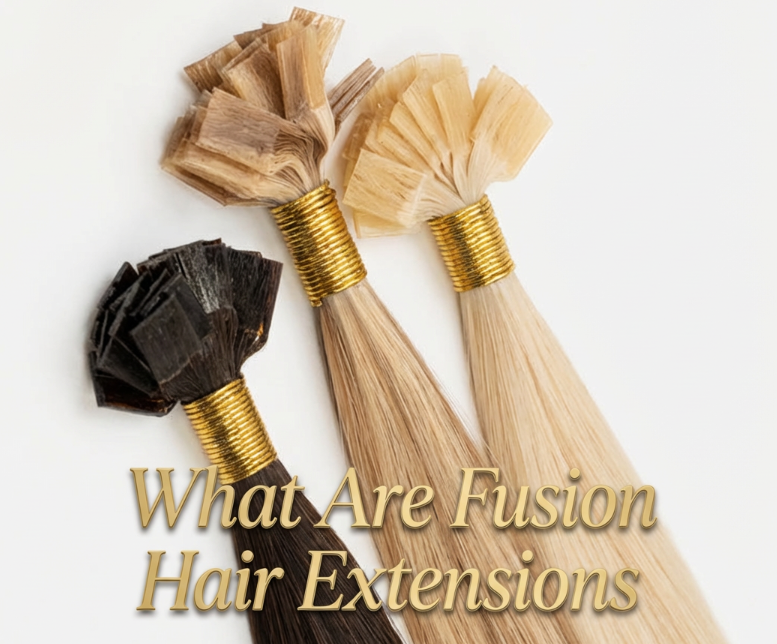
What Are Fusion Hair Extensions?
Fusion hair extensions, also referred to as keratin bond extensions, strand extensions, or sometimes mislabeled as glue-in extensions (though high-quality versions use no harsh glue), are a semi-permanent hair extension technique that uses keratin protein bonds to attach individual hair strands to natural hair. Keratin is the same protein that makes up human hair, nails, and skin, so this bond is gentle and suitable for most hair types. Unlike clip-in or tape-in extensions that come in wefts, fusion extensions allow for ultra-precise placement, meaning stylists can customize density, length, and position to match your natural hair growth pattern perfectly. The bonds are small, discreet, and virtually undetectable even when hair is pulled up, curled, or styled in tight updos.
Types of Fusion Hair Extensions
All fusion strands feature a keratin tip, but the shape and attachment method set them apart. Each is designed for different hair types, comfort levels, and styling needs.
Hot Fusion Extension Types
Hot fusion is the original fusion method, using controlled low heat to melt and seal keratin bonds to natural hair. These extensions have pre-formed keratin tips, melted at a temperature much lower than a standard curling iron or flat iron to avoid heat damage.
K-Tip (Flat Tip) Extensions
K-tip extensions are the most commonly used hot fusion type, which has a small, flat, square keratin bond. The bond lies close to the scalp with high concealment, suitable for most hair types, especially medium to thick hair, and blends well with natural layers.
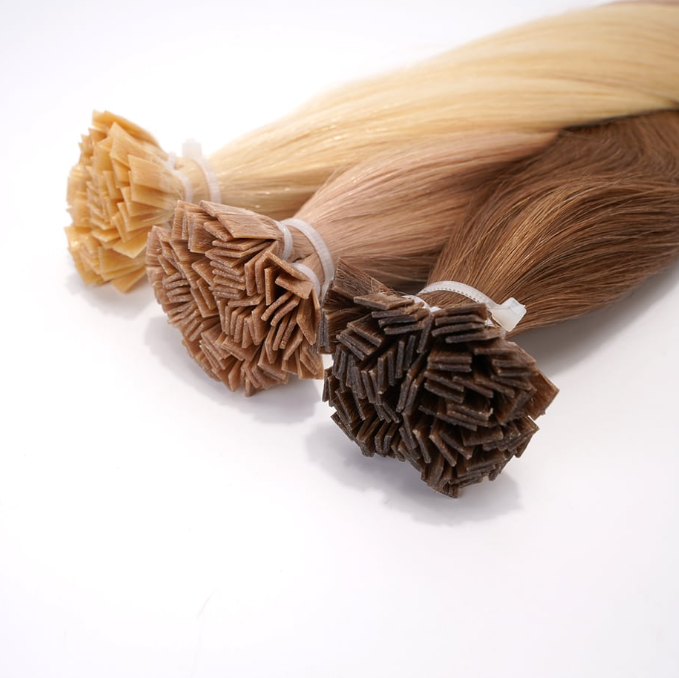
U-Tip (Nail Tip) Extensions
Equipped with a U-shaped keratin tip that wraps natural hair in its recess, reducing direct heat contact. The rounded bond is firm and durable for long-term wear, suitable for medium-textured hair.
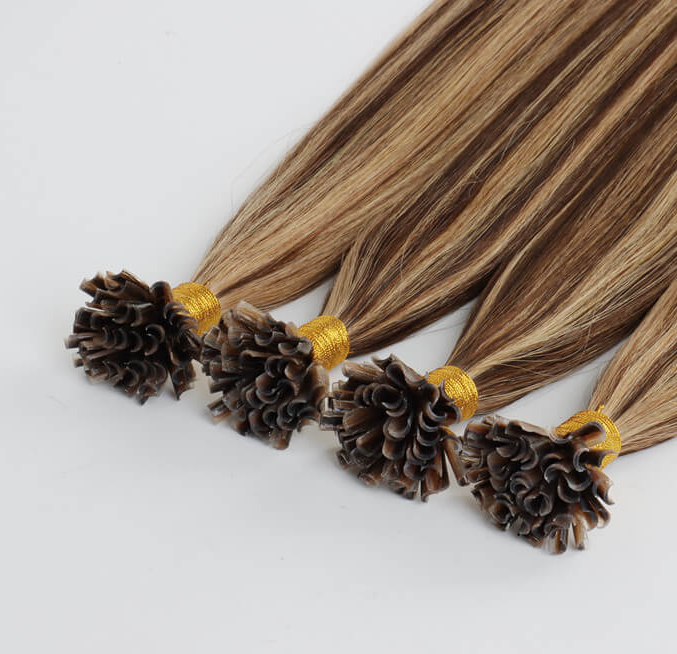
V-Tip Extensions
Adopt a slender, tapered V-shaped keratin bond with a small size and low volume. The bond minimizes bulk, lies flat against the scalp, and is less visible; it is suitable for fine hair.
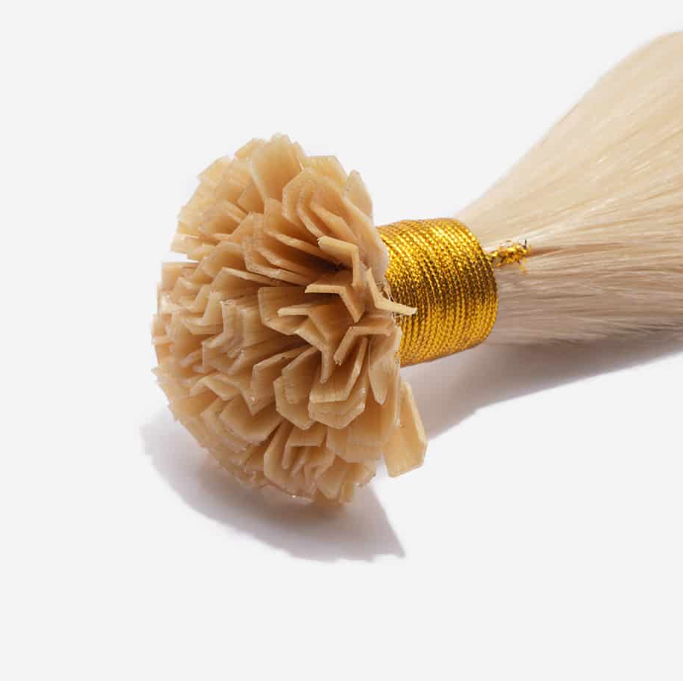
Cold Fusion Extension Types
Cold fusion extensions are heat-free and fixed by physical pressure, without heat or chemical adhesives, lowering the risk of hair damage. They are suitable for fine, fragile, or heat-sensitive hair.
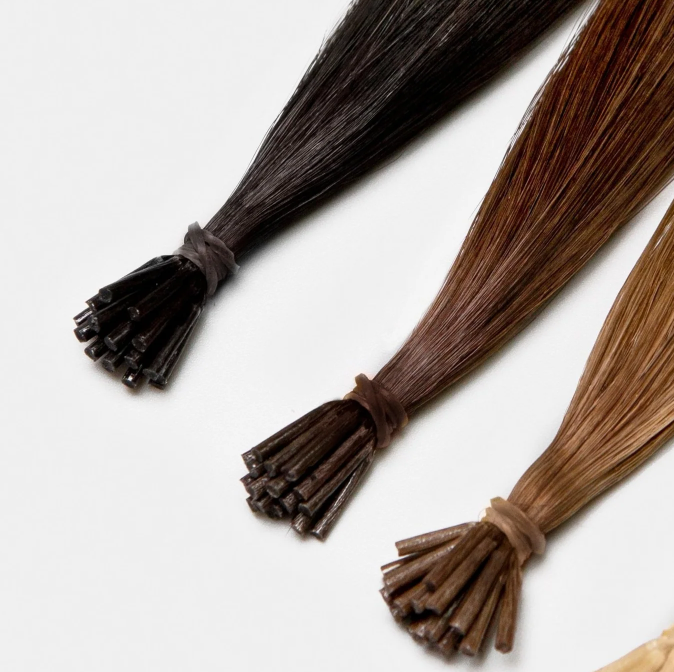
I-Tip (Micro-Link) Extensions
Have a long, cylindrical, I-shaped keratin tip fixed with silicone-lined microbeads. The silicone coating protects natural hair from breakage, and the beads are clamped to secure the strands. I-Tip extensions are reusable and versatile.
Nano Ring Extensions
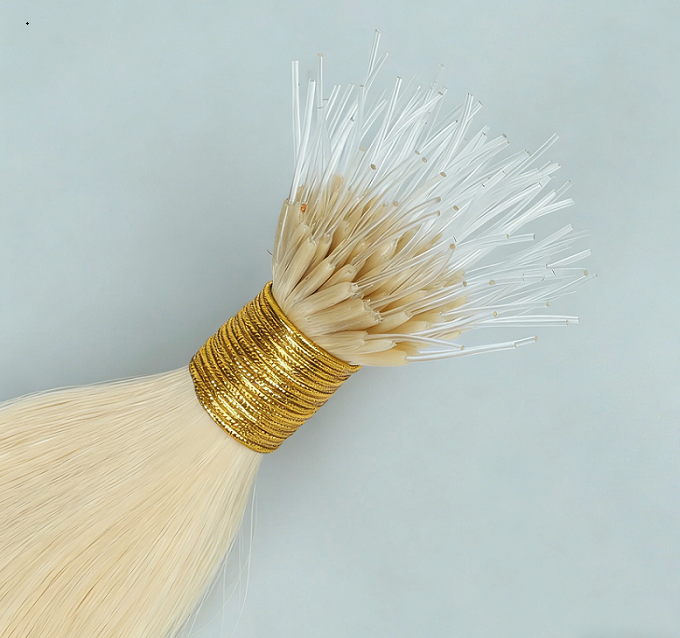
A more discreet micro-link extension using ultra-small nano rings with a diameter of less than 3 mm. The compact bond is nearly invisible, suitable for thin hair, short hair, and frequent updo styling.
Y-Tip Extensions
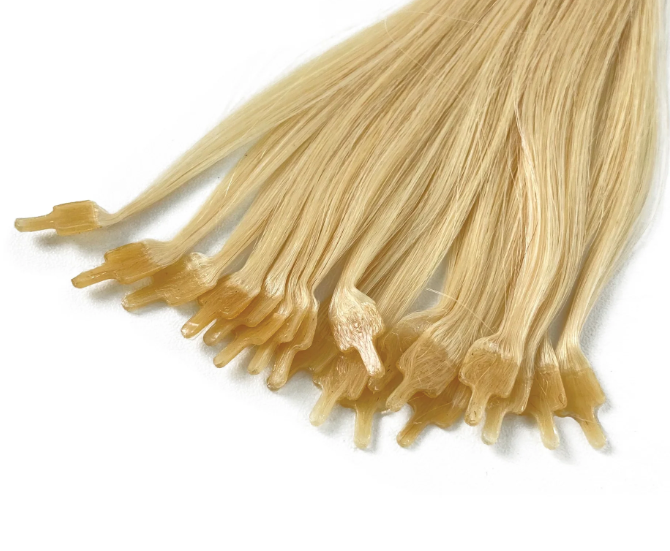
Features an ultra-thin flat Y-shaped tip, fixed with beads in the same way as I-Tip extensions. The bond is lightweight, causes no scalp irritation, and is suitable for first-time extension users.
Fusion Hair Extensions Before & After: What Real Results Look Like
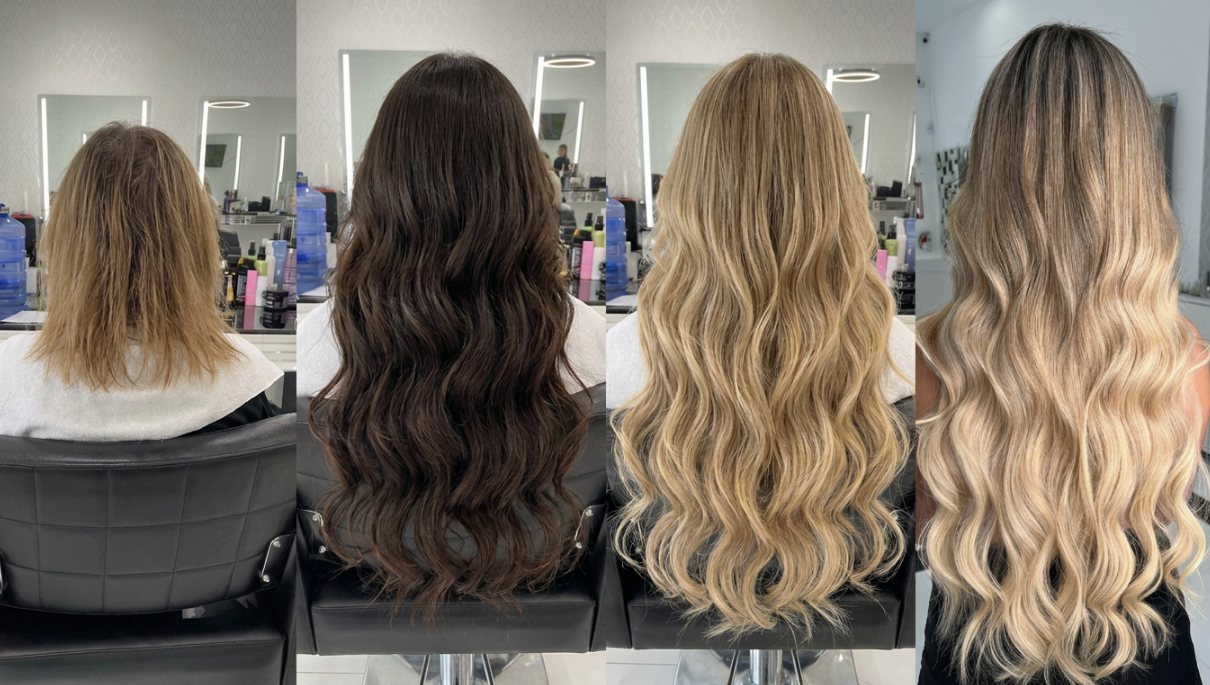
If you’re searching for fusion hair extensions before and after transformations, you likely want to know one thing: Will they actually look natural on me? Whether you’re dealing with fine hair, recovering from a bad haircut, or just craving length and volume, seeing real before-and-after results is the best way to set expectations. Below, we break down exactly what changes you can expect, by hair type, goal, and lifestyle.
Fusion Extension Before & After by Hair Type & Goal
1. Fine/Thin Hair → Full & Voluminous
Clients with fine hair are often told extensions won’t work for them. Fusion is actually an excellent choice here because each keratin bond is small and distributed across the scalp, minimizing tension on individual strands.
| Before | After |
|---|---|
| Hair lacks body, lies flat against scalp | Instant volume boost — 1.5x to 3x perceived density |
| Scalp visible through parting | Parting looks naturally dense |
| Ponytails feel skimpy | Ponytail circumference visibly increases |
Key insight: For fine hair, stylists typically use lighter bonds (0.5g per strand) and space them evenly to distribute weight. A good installation should feel weightless.
2. Short Hair (Bob/Lob) → Long & Versatile
This is one of the most dramatic transformations. Going from a shoulder-length bob to waist-length in a single appointment.
| Before | After |
|---|---|
| Limited to shorter hairstyles | Access to braids, updos, loose waves |
| One-length bob | Layered or blunt long hair, fully customizable |
| Heat styling restricted | Full freedom with curling irons, flat irons (up to 350°F / 180°C on bonds) |
Heads-up: The first 48 hours after installation will feel significantly heavier. Your neck and shoulders need a brief adjustment period — this is normal.
3. Thin Crown/Top Area → Natural Density Restoration
Many clients don’t want longer hair — they just want their existing hair to look fuller.
| Before | After |
|---|---|
| Crown parting appears wide | Closure or crown area filled in naturally |
| The top section feels thin to touch | Noticeable density improvement |
| Limited volume at the roots | Strategically placed bonds add lift |
Stylist tip: For crown thinning, a partial fusion install(30–60 strands vs. a full head of 150–300) is often the better approach. It’s lighter, cheaper, and easier to maintain.
4. Switching from Tape-In/Clip-In Extensions → Fusion
Clients who upgrade to fusion often report the biggest satisfaction jump.
| Before (Tape-In / Clip-In) | After (Fusion) |
|---|---|
| Visible tape tabs when hair is up | Completely invisible — no tabs, no wefts |
| Weekly re-taping required | 6–8 week maintenance intervals |
| Limited to straight-back placement | Bonds can follow natural growth patterns |
| Can slip or slide during workouts | Bonds hold firm through sweat and washing |
Fusion Hair Extensions Before and After Picture
How Long Until Results Look 100% Natural?
This is one of the most common questions from first-timers.
| Time | What to Expect |
|---|---|
| Day 1–2 | Hair feels heavier, bonds are noticeable when touching. You may sleep differently. |
| Day 3–7 | The weight settles. Hair moves more naturally. Blending improves. |
| Week 2 | Most clients report forgetting they’re wearing extensions. Blending is nearly seamless. |
| Week 3–4 | Your natural hair grows slightly into the bonds →the integration looks completely seamless. This is the peak “natural” phase. |
What Can Go Wrong? (A Realistic "After" Pitfall)
Not all before-and-after stories are positive — and being transparent here builds trust. A professional before & after starts with choosing the right stylist. Even the best hair won’t look good if installation or removal is rushed.
| Issue | Why It Happens | How to Prevent |
|---|---|---|
| Bonds become visible | Hair has grown out 1–2+ months beyond the maintenance timeline | Schedule a move-up every 6–8 weeks |
| Matting around bonds | Improper brushing technique (not starting from the ends) | Use a loop brush; brush 2–3x daily |
| Hair feels dry | Natural oils can’t travel down extension strands | Oil-based serums on mids/ends; wash 1–2x weekly |
| Breakage near bonds | Rough removal or DIY attempt | Always have a pro remove bonds with solvent |
Fusion Extensions Before & After Comparison vs. Other Extension Methods
| Extension Method | Length Change | Volume Increase | Natural Look (Rate 1–5) | Invisible in Updo |
|---|---|---|---|---|
| Fusion (Keratin Bond) | +12–22 in | High | ★★★★★ | Yes |
| Tape-In | +14–22 in | Medium | ★★★★☆ | No (tapes visible) |
| Clip-In | +12–24 in | High | ★★★☆☆ | No |
| Micro-Link (I-Tip) | +12–22 in | Medium | ★★★★☆ | Yes |
| Sew-In / Weft | +12–20 in | High | ★★★☆☆ | No |
Hot Fusion vs. Cold Fusion Hair Extensions: What Are the Differences?
The biggest divide in fusion extensions is between hot and cold application methods. Each has unique benefits, drawbacks, and ideal use cases—understanding the difference will help you choose the best fit for your hair.
| Category | Hot Fusion Hair Extensions | Cold Fusion Hair Extensions |
|---|---|---|
| Core Application Method | Uses controlled heat to melt pre-formed keratin adhesive bonds, fusing extensions to natural hair strand-by-strand. | Heat-free method; secures extensions strand-by-strand using microbeads/nano rings clamped with pliers. |
| Bond Type | Keratin-based adhesive bond (solidifies after cooling). | Mechanical bead/clamp bond (no adhesive). |
| Best Hair Type | Medium to thick, healthy hair. | Fine, thin, fragile, heat-sensitive, or damaged hair; sensitive scalps. |
| Installation Time | 1–4 hours (varies by volume), requires professional application only. | Faster than hot fusion (typically <1 hour), may be DIY-accessible with experience. |
| Durability & Lifespan | Lasts 3–6 months (up to 12–15 months with reapplication), minimal touch-ups needed. | Lasts 2–3 months, requires maintenance/tightening every 6–8 weeks. |
| Styling Versatility | Highly versatile; supports all hairstyles (updos, braids, heat styling) with discreet bonds. | Limited styling versatility compared to hot fusion; requires gentler handling. |
| Hair Damage Risk | Potential heat damage to fine/weak hair if applied incorrectly. | No heat exposure; lower damage risk when installed properly. |
| Removal Process | Requires professional removal to dissolve keratin bonds. | Easier, reversible removal by opening beads with pliers, no harsh chemicals. |
Fusion Hair Extensions vs. Tape-In Extensions
Fusion and tape-in extensions are both semi-permanent options. Which one should you choose? Below are their differences.
1. Attachment Method
Fusion hair extensions are attached strand by strand using keratin bonds, including hot fusion (with low heat) and cold fusion (without heat); tape-in hair extensions use medical-grade adhesive on pre-taped wefts, applied by sandwiching natural hair between two wefts.
2. Application Time
Fusion extensions take 2–5 hours to fully apply; tape-in extensions take 1–2 hours or as little as 30 minutes.
3. Reusability
Fusion extensions are not reusable after removal; tape-in extensions can be reused up to three times by replacing the adhesive tape.
4. Wear Duration & Maintenance
Fusion extensions last 3–12 months with proper care, requiring maintenance every 6–8 weeks; tape-in extensions last 4–8 weeks per application, with maintenance every 4–8 weeks.
5. Cost
Fusion extensions have a higher upfront cost; tape-in extensions have a lower upfront cost.
6. Suitable Hair Types
Fusion extensions are most suitable for medium to thick hair; tape-in extensions are ideal for fine, thin, or medium hair.
7. Removal Process
Fusion extensions require a special solution to break down keratin bonds and professional tools for removal; tape-in extensions use alcohol-based solutions to dissolve the adhesive.
8. Comfort & Weight Distribution
Fusion extensions use small individual keratin bonds with concentrated attachment points; tape-in extensions are lightweight and distribute weight evenly across the scalp.
9. Styling Versatility
Both allow heat styling and coloring, but fusion extensions offer greater freedom for updos, high ponytails, and 360° styling due to seamless bond blending.
Choose fusion extensions if you want long-lasting, invisible results and styling flexibility. Choose tape-ins if you want a quicker, more affordable temporary transformation.
How Many Fusion Extensions Do You Need for a Full Head?
The number of fusion strands needed for a full head installation depends on your hair goals, natural hair density, and desired length. Lots of brands sell fusion hair extensions in packs of 20 strands. Below are the recommended packs based on that.
Light volume/ subtle length: 5-6 packs (100-120 strands)
Medium volume & length: 7-8 packs (140-160 strands)
Full volume & long length: 9+ packs (180+ strands)
Stylists always adjust the count based on your natural hair—thicker hair can support more strands, while fine hair needs fewer to avoid weighing strands down.
How to Install & Apply Fusion Hair Extensions?
Fusion extension installation must be done by a trained, experienced stylist—DIY application risks severe hair damage, scalp burns, and uneven, messy results. Below is a step-by-step breakdown of the professional installation process:
Step 1: Consultation & Preparation
The stylist will assess your natural hair texture, density, and health to determine the right type of fusion (hot or cold), bond size, and number of strands. They’ll match the extension color, length, and texture to your natural hair for a seamless blend. Hair is washed and dried completely (no conditioner, as it can weaken bonds) and sectioned off neatly with clips.
Step 2: Installation
Option 1 - Hot Fusion Installation
The stylist takes a tiny, even section of natural hair (matching the size of the extension strand).
They place the keratin bond tip against the natural hair, roughly ¼-½ inch from the scalp to avoid irritation.
Using a specialized fusion tool, the stylist heats the keratin gently until soft and pliable.
Using protected fingers, the stylist rolls and molds the melted keratin around the natural hair to form a smooth, cylindrical bond.
The bond cools and hardens instantly, creating a secure seal. This process is repeated strand by strand, row by row, starting at the nape of the neck and moving upward.
Option 2 - Cold Fusion Installation
Natural hair is sectioned, and a small strand is threaded through a silicone-lined microbead using a loop tool.
The I-tip, nano ring, or Y-tip extension is inserted into the same bead.
Specialized pliers are used to clamp the bead tightly, securing the extension to the natural hair without heat.
Bonds are spaced evenly to distribute weight and avoid scalp tension.
Step 3: Blending & Styling
Once all strands are applied, the stylist trims, layers, and styles the hair to blend extensions with natural hair perfectly. The finished look is seamless, with no visible bonds or uneven patches.
How to Remove Fusion Hair Extensions Safely?
Just like installation, fusion extension removal should be done by a professional stylist—improper removal can cause hair breakage, scalp damage, and leftover keratin residue. Never yank, pull, or cut bonds at home.
Hot Fusion Removal
Hair is dried completely (wet bonds are harder to break down).
A professional keratin bond remover (alcohol-based solution) is applied directly to each bond and left to sit for 20-30 seconds to soften the keratin.
The stylist uses fusion pliers to gently crush and break the softened bond into small pieces.
The extension strand slides off easily; any leftover residue is combed out gently.
Hair is washed with a clarifying shampoo to remove remaining product and conditioned deeply to restore moisture.
Cold Fusion Removal
The stylist locates each microbead or nano ring and uses specialized pliers to gently open the clamp.
The bead expands, releasing the natural hair and extension strand.
Extensions slide off effortlessly, with no damage or residue left behind.
Hair is brushed and conditioned to refresh strands.
How Long Do Fusion Hair Extensions Last?
With professional installation and proper at-home care, fusion hair extensions last an average of 3-6 months. Influenced by various factors, such as the hair quality, your natural hair growth, maintenance, and salon touch-ups, the final lifespan can vary.
As natural hair grows, bonds shift downward from the scalp, making them more visible and potentially causing tension. Regular salon visits every 6-8 weeks to reposition bonds will extend the wear time and keep hair looking neat.
Proper Care & Maintenance for Fusion Hair Extensions
To extend the lifespan of your fusion hair extensions, follow these tips that can keep them looking shiny, tangle-free, and healthy.
Use Sulfate-Free Products: Sulfates break down keratin bonds and strip hair of moisture. Always use sulfate-free, alcohol-free shampoo and conditioner.
Wash Gently: Avoid scrubbing bonds directly; apply products from the mid-lengths to ends. Rinse with lukewarm water and pat dry—don’t rub vigorously.
Brush Correctly: Only brush dry hair with a loop brush or extension-safe detangling brush. Start at the ends and work upward to avoid tugging bonds. Never brush wet hair aggressively.
Limit Heat Styling: Excessive heat melts keratin bonds. Use low heat settings and always apply a heat protectant. Avoid heating bonds directly.
Sleep Smart: Braid hair loosely or tie in a low ponytail before bed to prevent tangling. Use a silk or satin pillowcase to reduce friction.
Avoid Heavy Products: Skip heavy oils, masks, and leave-in conditioners near the roots—they can weaken bonds and cause slipping.
Regular Salon Check-Ups: Visit your stylist every 6-8 weeks for bond adjustments and trims to keep hair looking fresh.
FAQs About Fusion Hair Extensions
Q: Are fusion extensions damaging to natural hair?
A: No—when installed and removed by a professional stylist, fusion extensions cause zero damage. Damage only occurs from DIY application, improper removal, overheated bonds, or wearing extensions longer than recommended.
Q: Can I dye or color fusion extensions?
A: Yes, high-quality Remy fusion extensions can be dyed, but it’s best to color them before installation. Coloring over bonds can weaken keratin and cause slipping. Always have a professional colorist perform the dye job.
Q: Does fusion extension installation hurt?
A: Most people feel mild pressure during installation, but no severe pain. Some experience slight scalp tenderness for 1-3 days afterward, which fades quickly as the scalp adjusts.
Q: Can I swim or workout with fusion extensions?
A: Yes! Rinse hair with clean water after swimming in chlorinated or salt water, and wash thoroughly soon after. Tie hair loosely during workouts to avoid tangling.
Q: Are fusion extensions reusable?
A: Cold fusion extensions are fully reusable with new beads. Hot fusion extensions can be reused if the old keratin tip is removed and a new bond is applied by a stylist.
Q: Can I wear my hair up with fusion extensions?
A: Absolutely! The small, discreet bonds are invisible in high ponytails, buns, braids, and updos.
The true quality of fusion hair extensions hinges entirely on the raw hair used, and our Thai hair is the ideal foundational material for making top-tier fusion extensions of every type. Sourced from single ethical donors in Thailand, this 100% unprocessed hair boasts fully intact, uniformly aligned cuticles with no chemical treatments or silicone coatings, fending off matting and shedding for the long haul, suitable for both hot and cold fusion extension strands. Its natural, soft texture forms an ultra-strong hold with keratin bonds, stands up to repeated color treatments and heat styling, and retains its integrity even with daily wear. For hair salons, retail stores, hair distributors, and anyone seeking premium hair for their own extension install, our factory-direct Thai raw hair bundles deliver exceptional durability and natural feel at wholesale pricing that fits any budget.